
Partnerships
Agriculture Innovation Center
The Agriculture Innovation Center provides technical and business development assistance to value-added agriculture producers.
About
Funded through the United States Department of Agriculture Rural Business-Cooperative Service, the Agricultural Innovation Center (AIC) program is designed to aid in the development and marketing of value-added products.
The Agricultural Innovation Center will provide the following services:
Business development services
Direct services and referrals related to feasibility studies and business planning.
Market development services
Assists valued added producers with marketing plans, branding, customer identification and market intelligence.
Process development services
Engineering services, scale production assessments, systems development, and other technical assistance related to development, implementation, improvement, and operations of processes and systems.
Value chain coordination
Connects value-added producers to distribution systems, developers and off-takers, processing facilities, and commercial kitchens.
Product development (excluding R&D)
Offers ideation, concept testing, feasibility and cost analysis, demographic and consumer analysis, production analysis, evaluation of packaging and labeling options, and brand development.
Eligibility
To be eligible for AURI’s Center, proposed value‐added agricultural projects must benefit agricultural products, demonstrate a positive impact to the agricultural economy and have commercial viability. Clients must also demonstrate the capacity and intent to commercialize their concept upon project completion.
AURI works with a client to plan, monitor, and implement a proposed project. Crop and livestock production projects are not eligible.
Important Definitions:
Value-Added – The incremental value that is realized by the producer from an agricultural commodity or product as the result of a change in its physical state, differentiated production or marketing, as demonstrated in a business plan, or Product segregation.
Also, the economic benefit realized from the production of farm or ranch-based renewable energy. Incremental value may be realized by the producer as a result of either an increase in value to buyers or the expansion of the overall market for the product.
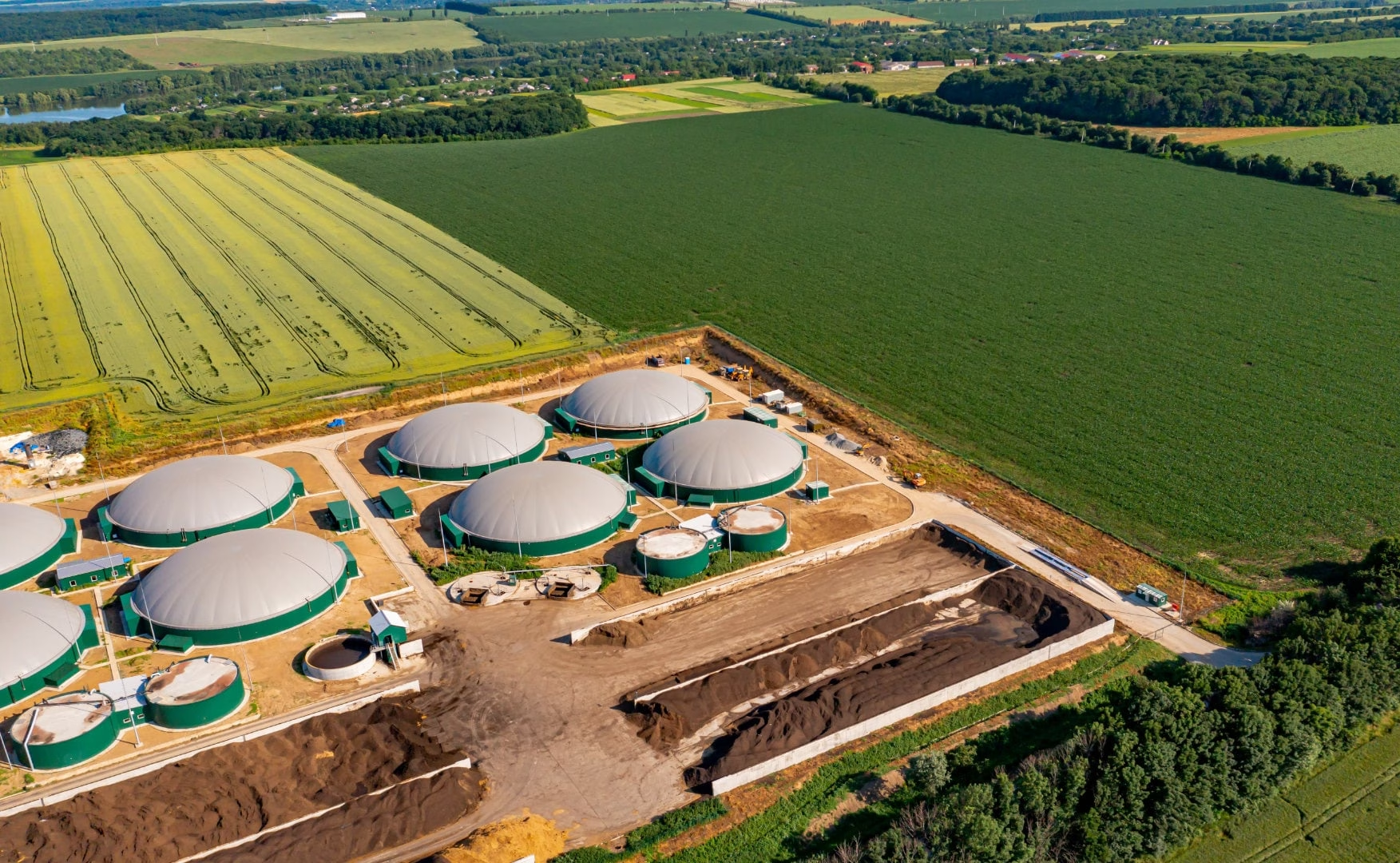
Examples include milling wheat into flour, slaughtering livestock or poultry, making strawberries into jam, the marketing of organic products, an identity-preserved marketing system, wind or hydro power produced on land that is farmed and collecting and converting methane from animal waste to generate energy.
Identity-preserved marketing systems include labeling that identifies how the product was produced and by whom.
Producer Services — Services to be provided by the Centers to agricultural producers. Producer Services consist of the following types of services:
- Technical assistance, consisting of engineering services, applied research, Scale Production Assessments, and similar services, to enable the agricultural producers to establish businesses to produce Value-Added agricultural commodities or products;
- Assistance in marketing, market development and business planning, including advisory services with respect to leveraging capital assets; and
- Organizational, outreach and development assistance to increase the viability, growth and sustainability of businesses that produce Value-Added agricultural commodities or products.
Persons or entities, including farmers, ranchers, loggers, agricultural harvesters and fishermen, that engage in the production or harvesting of an agricultural product. Producers may or may not own the land or other production resources, but must have majority ownership interest in the agricultural product to which Value-Added is to accrue as a result of the project.
Examples of agricultural producers include: a logger who has a majority interest in the logs harvested that are then converted to boards, a fisherman that has a majority interest in the fish caught that are then smoked, a wild herb gatherer that has a majority interest in the gathered herbs that are then converted into essential oils, a cattle feeder that has a majority interest in the cattle that are fed, slaughtered and sold as boxed beef, and a corn grower that has a majority interest in the corn produced that is then converted into corn meal.
An agricultural producer is a farmer, rancher, fisherman, or forestry harvester who produces or harvests (and owns) the product to which value will be added. An agricultural producer is not an entity (including an individual) who buys an agricultural product from someone else and then adds value.
An agricultural producer adding value to his or her product can purchase additional product up to the amount of their own product. That is, over 50 percent of the product to which value is being added must be produced by the agricultural producer.
How to Apply
The Agricultural Utilization Research Institute (AURI) enables businesses utilizing Minnesota agricultural products to bring new, innovative value-added products and technologies to the marketplace. The Center helps clients achieve their commercialization goals by assessing their needs and business concepts.
AURI’s Center, one of six centers across the U.S., provides the following services:
- Business development services. The Center provides direct services and referrals related to feasibility studies and business planning.
- Market development services. The Center assists businesses with marketing plans, branding, customer identification, and market intelligence.
- Process development services. The Center provides engineering services, scale production assessments, systems development, and other technical assistance related to the development, implementation, improvement, and operations of processes and systems.
- Value chain coordination. The Center connects businesses to distribution systems, developers, off-takers, processing facilities, and commercial kitchens.
- Product development (excluding R&D). The Center offers ideation, concept testing, feasibility and cost analysis, demographic and consumer analysis, production analysis, evaluation of packaging and labeling options, and brand development.
For all projects download the General Commercialization Services Program Guidelines.
Articles




Guides
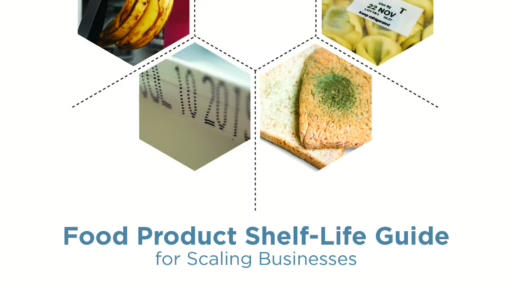
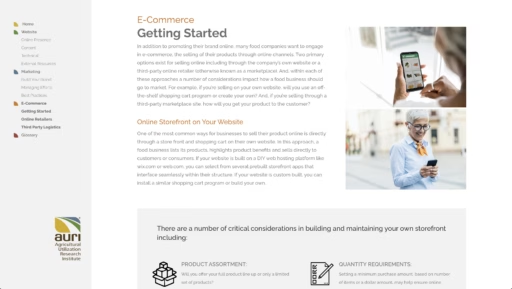
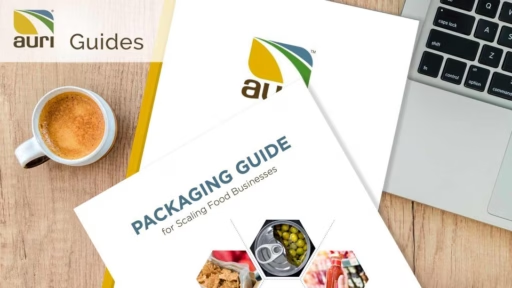
AURI publishes a number of helpful guides for public disseminations. The following guides specifically relate to the work of AURI’s Agriculture Innovation Center Program.
Research Reports
Through practical, applied research AURI identifies emerging opportunities to add value to agriculture products. This information is publicly available in order to help entrepreneurs and businesses generate ideas for new products and processes.
- Kernza® Perennial Grain Value Chain Development in Central Minnesota
- Halal + Kosher Minnesota Meat Market Assessment
- Building an Industrial Hemp Industry in Minnesota
- Local Sourcing for Food Manufacturing in Minnesota
- Minnesota Aquaculture: Opportunities & Challenges
- Assessment of Consumer Perceptions, Preferences and Behaviors
- Omega 3 Claims Guide
- A2 Milk Market Assessment
Market Spotlights
The following market spotlights provide market information to producers wanting to know more about different agricultural sectors in Minnesota. Each report contains knowledge of different market opportunities existing in Minnesota while outlining the total addressable market, supply and demand, and market channels.
- Meat Goat Market in Minnesota
- Specialty Oilseed Market in Minnesota
- Grass Seed Market in Minnesota
- Oats Market in Minnesota
- Compost Market in Minnesota
- Small-Scale Dairy Processing
- Halal Meat in Minnesota
- Small and Artisan Grains Market in Minnesota
- Minnesota Wool Market
- Industrial Hemp Market in Minnesota
Value-Added Market Research Video Series
The following market spotlights provide market information to producers wanting to know more about different agricultural sectors in Minnesota. Each report contains knowledge of different market opportunities existing in Minnesota while outlining the total addressable market, supply and demand, and market channels.
Board of Directors
The Center is governed by a board of directors made up of representatives of commodity groups, agribusinesses and members of the Minnesota legislature.

Legislative Appointment
MN House
MN House

Term Expires: January 2027
MN Farm Bureau
MN Farm Bureau

Legislative Appointment
MN Senate
MN Senate

Term Expires: January 2029
MN Soybean Research & Promotion Council
MN Soybean Research & Promotion Council

Term Expires: January 2027
MN Wheat Research & Promotion Council
MN Wheat Research & Promotion Council

Term Expires: January 2027
MN Farmers Union
MN Farmers Union
More to Explore

See How We Can Partner to Make Your Idea a Reality