Overview
A coproduct is a material produced alongside a primary product from agricultural commodity processing. Examples include but are not limited to distillers’ grains from ethanol production, bran fractions from milling, whey from dairy processing, press cakes from oil extraction, and fiber streams from food manufacturing.
These materials may have established markets or may be underutilized and treated as low-value outputs or waste. Coproduct development focuses on improving the value, marketability, and consistency through characterization, upgrading, derivative product development, or improved handling and logistics.
We provide applied research, product and process development, pilot-scale capabilities, and business development support to help move a coproduct concept from early feasibility through demonstration and commercialization planning.
We engage with entrepreneurs, established manufacturers, agricultural processors, technology providers, and public-sector partners. Our work bridges the gap between laboratory research and commercial-scale implementation.
Deliverables are typically designed to support decision-making and may include compositional and functional data, pilot-produced samples, process recommendations, and project assessment outputs using stated assumptions and realistic assessments of market conditions.
Services
AURI’s services are valuable during concept validation, feasibility assessment, and pilot demonstration phases. Early engagement allows characterization and screening work to inform product strategy before significant capital investment, while pilot-scale work generates samples and data needed for customer validation, regulatory submissions, and investor discussions.
- Techno-economic analysis (TEA) and scenario/sensitivity analysis based on measured results and clearly stated assumptions
- Evaluation of coproduct supply strategies, seasonal variability, logistics considerations, and preliminary product positioning
- preliminary market assessment support, including target customer identification and competitive positioning
- identification of technical gaps, regulatory pathways (GRAS determination, feed approval, industrial certifications), and next-step work plans appropriate to the project stage
- analysis structured to support financing discussions, grant applications, and partnership development
- Composition and variability testing aligned with intended use: moisture, ash/minerals, protein, fiber fractions, lipids, sugars, key quality indicators, and functional properties
- Screening for relevant contaminants or constraints based on target market (food, feed, industrial, or energy applications) and applicable regulatory frameworks (FDA, AAFCO, EPA)
- Shelf-life and stability evaluation under relevant storage and handling conditions
- Batch-to-batch variability assessment to inform quality control and supply consistency requirements
- Practical guidance on sourcing, handling, storage, and pre- or post-processing based on measured properties
- Concept screening and pathway selection aligned with target markets, product specifications, and regulatory requirements
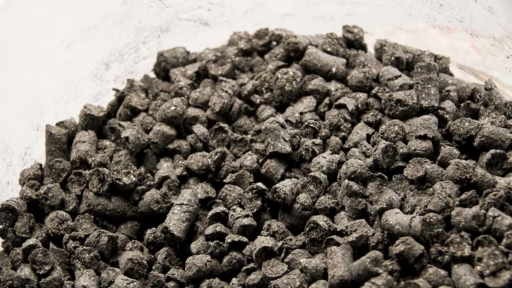
- Process development for separation, fractionation, conversion, purification, and densification (pelletizing, extrusion, drying) as relevant to the coproduct and target product
- Definition of measurable performance criteria (yield, purity, functionality, stability) and structured test plans
- Prototype development and bench-scale iteration to meet target performance requirements
- Application-specific testing: physical properties, functional performance, stability, compatibility with downstream processing, and end-use requirements
- Sample production for customer evaluation or early market testing, typically from several kilograms to multiple tons, depending on application and scale requirements
- Documentation appropriate for customer technical data sheets or regulatory submissions
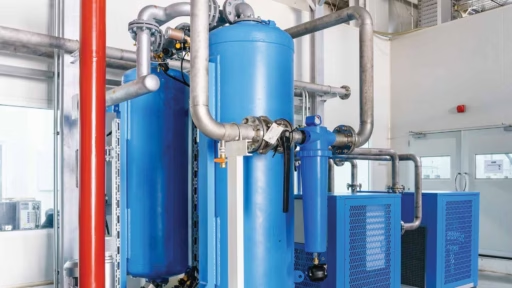
- Pilot-scale processing (batch sizes ranging from a few pounds to several tons) to generate representative samples and inform scale-up considerations
- Identification of operating parameters likely to affect performance at commercial scale, with uncertainties noted
- Equipment and process recommendations based on observed handling characteristics, throughput constraints, and product quality requirements
- Translation of lab and pilot findings into practical inputs for engineering, manufacturing, and commercialization partners