
Green Ammonia: A Low Carbon Solution and Economic Driver for Rural Minnesota
Update to 2023 AURI Report “Securing a Better Future Through the Development of Green Ammonia Fertilizer Pathways” Read the full report
AURI conducts applied research initiatives to raise awareness of emerging commercial products, evaluate key trends, and help derisk future industry opportunities.

For growers, governments, supply chain sectors and end users who are engaged in the emerging hemp industry in Minnesota.
Update to 2023 AURI Report “Securing a Better Future Through the Development of Green Ammonia Fertilizer Pathways” Read the full report
As part of its Protein Catalyst initiative, the MBOLD Coalition commissioned this assessment to evaluate opportunities to incorporate winter camelina into animal feed rations and contribute to the sustainability of…
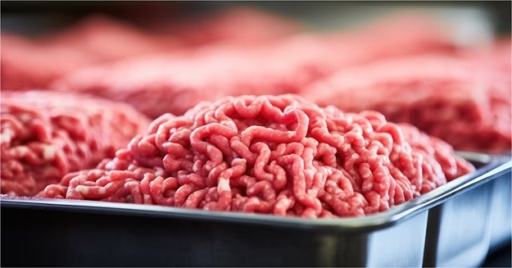
This phase 2 project identified more sustainable packaging options for consumers to prevent ground beef food waste and analyzed how these findings can assist in effectively communicating future sustainability goals…
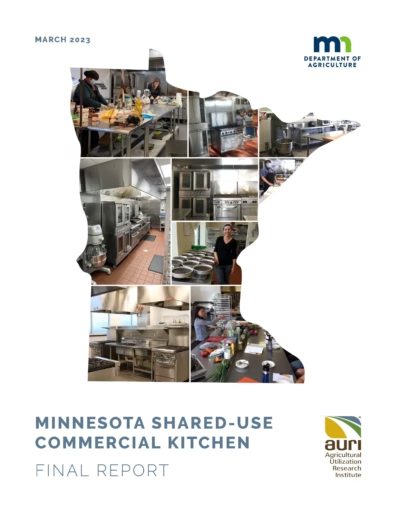
The Agricultural Utilization Research Institute, in partnership with the Minnesota Department of Agriculture (MDA), commissioned a research report to develop a better understanding of the shared commercial kitchen business model…
The United States Department of Agriculture-Agricultural Research Service (USDA-ARS) and the University of Minnesota (UMN) conducted a research project to test whether carbon (C) additions to a combination of woodchips…
The United States Department of Agriculture-Agricultural Research Service (USDA-ARS) conducted a research project to investigate the performance of agriculturally derived residue materials in bioreactors. This included a comparison of the…
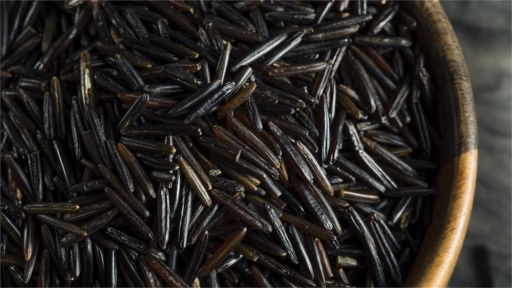
The University of Minnesota (UMN) and the Agricultural Utilization Research Institute (AURI) partnered on a research report on Minnesota’s Cultivated Wild Rice.
A new report that assesses the current state of “ready to scale” food and beverage businesses.
Globally, aquaculture is one of the fastest-growing food industries. The key drivers are technological developments, increased production, and growing understanding of the health benefits of fish consumption. Learn more about aquaculture in Minnesota and where this exciting industry is headed.
Food fish comprise a diverse category in Minnesota from its legendary walleye to trout. Besides wild caught fishing, which goes back
many generations, commercially viable fish farm opportunities have been expanding as an interest area in recent years, creating
employment, economic impact and growth for related sectors in the form of fish feed, fish health and byproducts.
Potential for cost savings is an important driver for new asphalt pavement preservation techniques. This study evaluated the cost effectiveness of RePlay Agricultural Oil and Preservation Agent® (“RePlay”), a biobased…
This report illustrates the impact of the novel Coronavirus Disease (COVID) on supply chains for Minnesota food and agriculture manufacturers and processors. A collaboration providing services to Minnesota food and agricultural economic sectors wanted to better understand the supply chain effects of COVID, the resulting pain points and what may be needed to help identify potential new services, resources and supportive actions that would improve supply chain resiliency for Minnesota businesses.
This research identifies and evaluates more sustainable packaging options that improve consumer confidence by providing tangible and consumer-visible demonstrations of the beef industry’s commitment to reducing its carbon footprint.
Small to mid-sized food manufacturers represent a growing sector within the food industry, and as such have the potential to provide new market channels for Minnesota’s agricultural producers. With the…
The markets for halal and kosher meat in Minnesota hold untapped potential for communities throughout the state. On the consumer side, Minnesota is home to thousands of people with an unmet preference for fresh, high quality, and affordable meats processed using halal or kosher methods. On the producer side, many farmers and ranchers across the state are looking for new markets and have an interest in serving these consumers. Each stop along the supply chain requires understanding the requirements for halal and kosher production.
AURI is pleased to present this preview of an upcoming Minnesota Hemp Value Chain Analysis report to the growers, governments, supply chain sectors and end users who are engaged in the emerging hemp industry in Minnesota.
AURI was interested in quantifying the contribution of its programs in Minnesota. Thus, you hired University of Minnesota Extension to conduct an economic contribution study. The economic contribution study measured the direct effect of AURI’s business assistance (operating revenues, capital expenditures, and jobs). AURI provided all required data to Extension. Extension then used an input-output model (IMPLAN) to measure the total effect on the state of Minnesota.
The report contains information on plant protein sources that are currently available, emerging, or potentially viable sources of proteins. It summarizes current knowledge, advantages, barriers, and areas requiring further investigation. Additionally, it provides basic information, which helps Minnesota entrepreneurs explore the potential of utilizing various regional plant protein sources in various food applications to address the growing market demand for such products.
In August 2017, AURI and the Stine Group emailed a survey to 167 Nutrition Services Directors (NSDs) in 120 Minnesota school districts. The goal of the survey was to gauge NSDs levels of understanding and interest in Clean Label products for their programs. Additionally, the survey inquired about their willingness and ability to purchase value-added foods processed in Minnesota.
Read the full report: Development of a Port-Injected Hydrous Ethanol System for Diesel Engines
Read the full report: Effects of Feeding Reduced-Fat Modified Distillers Grains with Solubles on Dietary Energy Values, Finishing Cattle Performance and Beef Quality Characteristics
Information detailed in this study guide can be utilized to make informed decisions on the feasibility of utilizing a biomass system, whether as a main source of heating and cooling or as an auxiliary system. It serves as a potential opportunity to reduce heating and cooling cost, especially if the current energy source being used is propane or fuel oil.
The potential long-term outcome of this research is the development and promotion of on-farm energy production using a combination of corn stover and distillers grain as a feedstock to improve the sustainability of corn production with biochar amendments.
This research demonstrates that ethanol plants can grow this particular market for their feed products, while livestock producers get a simple, low-cost, effective feed ration.
Results indicate feeding high levels of corn or soy coproducts in feedlot heifer diets does not have an effect on carcass characteristics, drip loss, or subjective retail shelf life evaluation; however, combining all coproducts in a low grain inclusion diets impacted objective measurements of tenderness.
This research can help direct cattle producers on design, construction and management of their feeding operations to effectively raise cattle along with gaining greater economic value to manure. The manure can be applied to corn and other crop fields for potentially enhanced yields.
Reduced oil concentration in DDGS has minimal, if any, effect on growth performance and carcass com The reduced oil concentration in DDGS generally improves pork fat quality when high levels of DDGS are added to growing-finishing diets, but the magnitude of this improvement is not proportional to the change in oil content among DDGS sources.
This research was to work to understand consumers’ perceptions about various fluid milk products that are available in the market. This research looked at two variables related to milk and taste perception. The objective of the first part was to understand consumers’ expectations and evaluate the impact of a sensory experience upon perceived value of fluid milk in translucent high-density polyethylene (translucent plastic), white-pigmented high-density polyethylene (lightblock), and paperboard. The objective of the second part was to understand consumers’ expectations and evaluate the impact of a sensory experience upon perceived value of fluid milk at the beginning and end of code.
Thin stillage from corn ethanol plants is currently utilized by adding it to DDG and subsequently drying the blended streams to yield DDGS. This is convenient since it avoids treating the thin stillage as a waste stream. Generating new value-added products from the thin stillage stream offers an opportunity to add more positive cash flow to the equation independent of corn prices.
This project shows that feeding DDGS does not cause defects in Swiss cheese; and can be utilized by ethanol and dairy producers when making decisions about their feed rations.
This study suggests that reduced-fat distillers grains can replace full-fat distillers grains in feedlot diets without having a negative impact on growth performance, carcass, or meat quality characteristics up to 20% dietary dry matter. Moreover, both reduced- and full-fat distillers grains can effectively replace dry rolled corn in feedlot diets.
Results from this project will provide information regarding whether or not feeding DDGS is a causative factor in foaming of swine manure and provide insights on the amount of long-chain fatty acids and fiber in swine manure necessary to cause foaming.
Agbioscience is a critical component of Northeast Minnesota’s past and future. A new research report shows that in 2013 agbioscience supported $2.1 billion in economic impact—seven percent of the region’s total economic output. And with the right steps and action, agbioscience could drive additional long-term prosperity in this region of the state—potentially growing to an estimated $2.9 billion in output in 2016.
This project was driven by the building and trade industry’s desire for an alternative to many petroleum base resins. The industry is looking for cost stability, sustainable and comparable bio resin options.
Agbioscience is a critical component of Northwest Minnesota’s past and future. A new research report shows that in 2013 agbioscience supported $789.4 million in economic impact—five percent of the region’s total economic output. And with the right steps and action, agbioscience could drive additional long-term prosperity in this region of the state—potentially growing to $1.3 billion in economic output in 2016.
Agbioscience is a critical component of Central Minnesota’s past and future. A new research report shows that in one year alone agbioscience supported $2 billion in economic impact—four percent of the region’s total economic output. And with the right steps and action, agbioscience could drive additional long-term prosperity in this region of the state—potentially growing to $3.1 billion in economic output in 2016.