Biobased Products
Industry Solutions

Biobased Products

AURI helps bridge the gap between scientific and technical innovation and industrial production.

Overview

To support biobased efforts, AURI provides applied research, product and process development, pilot-scale capabilities, pilot trials, demonstrations, and commercialization support. Much of this work involves developing new processes for new products from novel or existing agricultural-derived feedstocks.

Many of the same technical tools and go-to-market mechanics also apply to the value-added use of existing side streams and coproducts, because scale-up and market risks start to look similar beyond the lab. We also assist with pilot programs to advance market awareness.   

There are multiple benefits to working with AURI to advance and support your biobased product development.  

  • We work with fibers, oils, and fractions. 
  • We translate data and research into commercial insights to inform you about opportunities and key next steps.  
  • We are connected to industry to make potential referrals and help form new business relationships where synergies may exist. 
  • Additionally, AURI’s location in the Upper Midwest provides robust access to diverse agricultural feedstocks, supply chains, and processing infrastructure. 

Whether you are just getting started or scaling production, AURI has a range of tools and expertise to support your efforts to help you move forward with confidence.  We can help reduce input risk before making capital investments, use our insights to translate lab concepts and prototypes into repeatable processes, assist in creating products for future customers, and help build business cases with clear assumptions.  

Services

Commercialization

AURI supports early proof-of-concept to full commercial rollout, when a product idea is technically plausible, but success depends on repeatability, specifications, manufacturability, scale-up behavior, and a credible path to market. Technical development and commercial viability are inseparable, and AURI addresses both as parts of the same problem.

Typical situations where AURI adds the most value:

Specifications Definition

A material can be made at bench scale, but not consistently enough to define a defensible product specification.

Translation to Scale

Lab conditions need to be translated into operating parameters that still work at higher throughput.

Sample Demand

Representative samples, from kilograms to tons, are needed for customer validation, qualification, or early market testing.

Economic Clarity

A cost and risk picture is needed, based on real data and explicit assumptions rather than optimistic estimates

Operational Constraints

Practical factors that influence scale-up success need to be identified, including feedstock variability, handling, stability, impurities, equipment fouling, and yield or quality tradeoffs.

Market Validation

Target markets and customer segments need definition, or existing assumptions need to be tested against real market conditions.

Business Case Development

A business case needs to be built or strengthened to support investment, partnership, or go-to-market decisions.

Feedstocks

AURI works across fibers, oils, and functional-fraction streams, leveraging the region’s agricultural diversity, including hemp, flax, corn, soybeans, and others, to develop processes applicable to a wide range of biomass products.

Typical situations where AURI adds the most value:

Fiber

Bast fibers and hurd/shives from hemp, flax, and similar crops for biocomposites, nonwovens, molded fiber parts, insulation, panels, and other industrial materials

Fiber streams from food and grain processing, validated for performance and supply consistency, as fillers or reinforcement

Oils and Oleochemicals

Vegetable oils, including soybean , as inputs to coatings, resins, plasticizers, lubricants, surface modifiers, and surfactant precursors

Gums and lecithin-type fractions as formulation aids, including compatibilizers, dispersants, and emulsifiers, when they meet performance and market requirements.

Functional Fractions

Protein- and fiber-rich fractions such as meals and press cakes as binders, fillers, or functional additives.

Benefits of Working with AURI

  • Composition and Variability Testing: Evaluating batch-to-batch consistency and functional properties aligned with the intended industrial application.
  • Constraint Screening: Early identification of potential barriers, including impurities, handling issues, and regulatory considerations that could affect production.
  • Logistics and Stability: Shelf-life and storage assessment under real-world conditions to inform sourcing, preprocessing, and inventory strategies.

  • Pathway Selection: Screening processing options to select practical routes for separation, fractionation, purification, conversion, or densification, as relevant.
  • Specification and Test Planning: Translating product concepts into measurable performance criteria and structured test plans aligned with end-market needs.

  • Bench-Scale Iteration: Iterating operating parameters to hit performance targets required by customers and applications.
  • Market-Ready Samples: Producing representative samples, from kilograms to tons, for customer qualification, field testing, and early commercial validation.

  • Scale-Representative Processing: Pilot-scale trials that generate data and samples relevant to scale-up and manufacturing decisions.
  • Operational Sensitivity: Identifying practical breaking points, including equipment fouling, yield tradeoffs, and operating windows, so they can be addressed before capital investment.
  • Engineering Handoffs: Providing grounded data, parameters, and lessons learned to support engineering partners designing full-scale facilities.

  • Grounded Economics: Techno-economic analysis using measured results to inform cost models and key sensitivities.
  • Market and Regulatory Work: Clarifying target segments, assessing competitive context, and outlining regulatory pathways as appropriate.
  • Clear Next Steps: Work plans outlining what needs to be proven next, at what scale, and with what success criteria.

Our Team

AURI’s Food scientists are available to provide consulting and technical services in the areas of product and process development, product evaluation and testing, sourcing materials, equipment and services

Alan Doering
Senior Scientist, Coproducts
Jimmy Gosse
Senior Scientist, Biobased & Renewable Energy
Brad Matuska headshot
Business Development Director of Biomass Feedstocks
Camren Nikoley
Bioindustrial Lab Associate
Photo of John Sorensen
Bioindustrial Facilities Manager
Michael Sparby
Commercialization Director
Harold Stanislawski headshot
Business and Industry Development Director
Photo of Shelby Thooft
Associate Scientist, Chemistry
Jennifer Wagner-Lahr
Senior Director of Business Development and Commercialization
Photo of Luca Zullo
Sr. Director of Science and Technology

Facilities

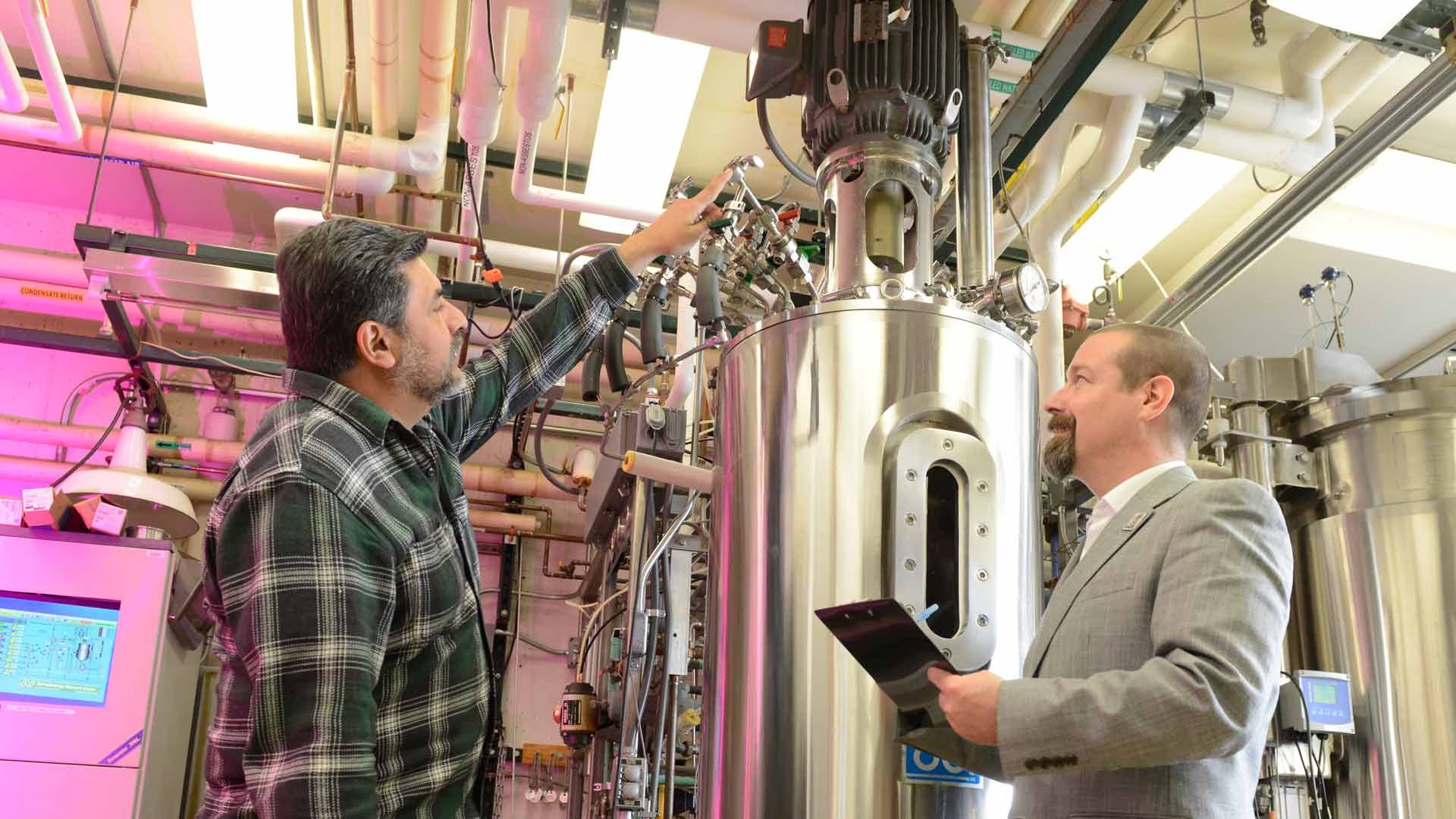
AURI’s laboratories are available to clients for hands-on testing and development.
field
See How We Can Partner to Make Your Idea a Reality
Ava - Accessibility Widget