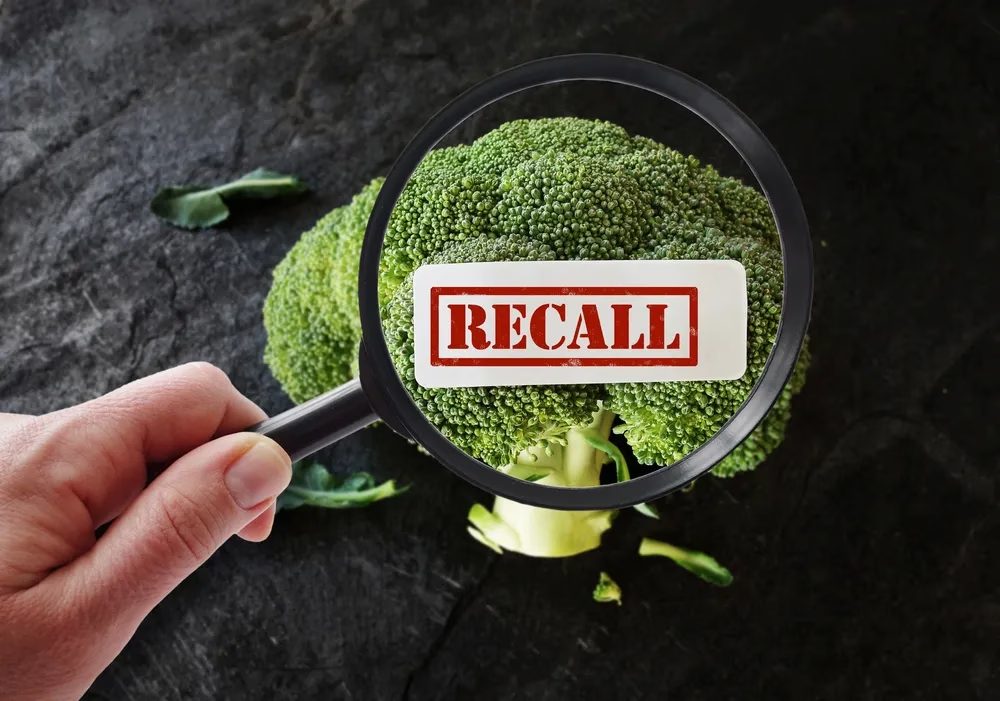
- A food recall is a company’s action to remove or correct food that may be unsafe or mislabeled.
Read full summary ▾
- The FDA and USDA share oversight of food recalls, and each recall is assigned one of three classes based on health risk.
- Undeclared allergens, harmful bacteria, and foreign material are regular causes of recalls.
- Food recalls follow a defined regulatory process from discovery and risk evaluation through notification, effectiveness checks, product disposition, and close-out.
- Food businesses can reduce their risk by conducting label checks, maintaining a food safety plan, keeping lot records, and having a tested recall plan.
You’ll learn the two questions that decide whether an action legally counts as a recall, and why a product can be publicly named even when no recall happens. The article shows which recall steps fall to the company and which to the regulator, including a step a company can take before the FDA finishes its review.
A food recall refers to when a company pulls food from the market because it may be unsafe or mislabeled. Recalls can involve anything from an allergen missing on a label to pathogenic bacterial contamination like Salmonella or Listeria in a ready-to-eat product. For food businesses, knowing how recalls work makes them easier to prevent and respond to properly if they happen.
This guide explains what counts as a recall, who oversees recalls, how they’re classified, and what Minnesota food makers can do to lower their risk.
We’ll discuss the following:
- What is a food recall?
- Who oversees food recalls in the U.S.?
- What are the three classes of food recalls?
- Why do foods get recalled?
- What are the steps in the food recall process?
- How can a food business reduce recall risk and prepare for a recall?
- Frequently asked questions
Launching or scaling a food product in Minnesota? AURI’s Food Team offers guidance on labeling, food safety, and regulatory requirements, from early product design through scale-up.
What is a food recall?
A food recall is the removal or correction of food that may be adulterated (harmful or unfit to eat) or misbranded (labeled in a false or misleading way). Most recalls are voluntary, meaning the company starts them on its own or at the FDA’s request. In some cases, the FDA can also order one.
Under the U.S. Food and Drug Administration (FDA) rules, a recall is a company’s removal or correction of a marketed product that the FDA considers in violation of the law and subject to legal action, such as seizure. Whether an action counts as a recall comes down to two questions: has the product left the company’s control, and is the violation serious enough to warrant FDA action?
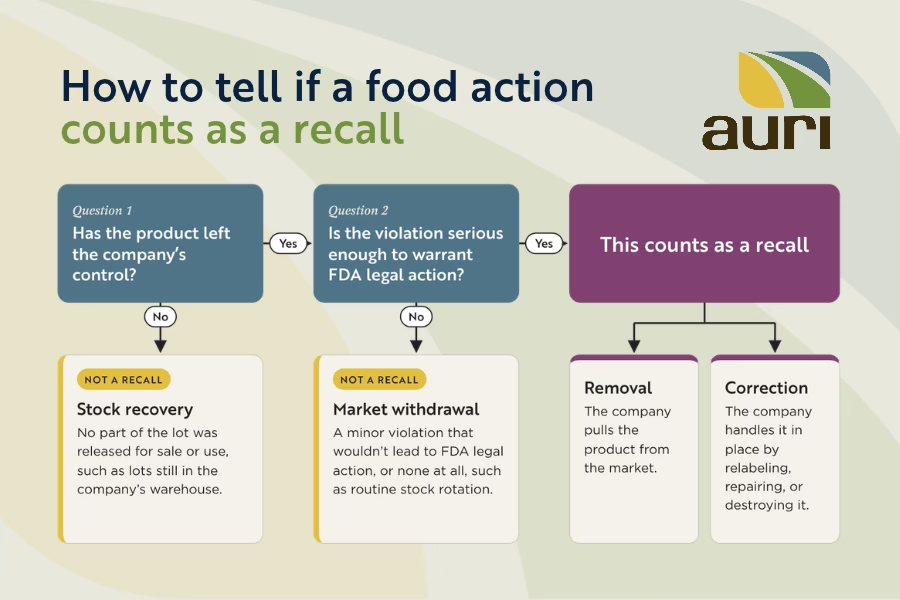
- Stock recovery. If the answer to the first question is no, i.e., the product has not left the company’s control, and no part of the lot has been released for sale or use, this does not count as a recall, however serious the problem. Because the product never reached the market, no recall is needed.
- Market withdrawal. If the answer to the second question is no, a recall is also unnecessary. The product has left the company’s control, but the issue is a minor violation that would not lead to FDA legal action, or no violation at all, if, for example, a routine stock rotation can be implemented. The FDA offers another example of a market withdrawal that avoids a full recall: a product pulled after tampering when there is no sign of a manufacturing or distribution problem.
- Removal. If the answer to both questions is yes, i.e., the product has left the company’s control, and the violation is serious enough to warrant FDA action, the company pulls the product from the market. This is a recall.
- Correction. The answer to both questions is also yes, but the company handles the product by relabeling, repairing, or destroying it. No product removal from shelves takes place. This still counts as a recall.
What is a voluntary recall?
A recall is considered voluntary because the company decides to conduct it, either on its own or at the FDA’s request. Companies still have a strong reason to agree. Under FDA policy, a recall is an alternative to court action, and the FDA considers it the better way to protect consumers once a product has been widely sold. If a company refuses a recall the FDA has requested, the FDA can go to court to seize the product instead.
Once a recall starts, it is tracked closely. The FDA posts every new recall in its weekly Enforcement Report, which is publicly available. The company also sends the FDA regular progress updates, usually every two to four weeks, until the recall is officially closed.
How is a public health alert different from a recall?
A public health alert warns people about a possible health risk in a food product, usually when a recall cannot be recommended. For meat, poultry, and egg products, the Food Safety and Inspection Service (FSIS) may issue a public health alert when it needs to inform consumers about a potential risk but a recall is not being conducted, including situations where the affected product is no longer available for purchase:
- Illnesses are linked to a product, but the source isn’t pinned down. FSIS can’t yet identify which specific product to recall.
- The product is likely no longer for sale. It still poses a risk, but there is nothing left in stores to pull.
- The company refuses to recall the product. In that case, FSIS can also move to detain or seize it.
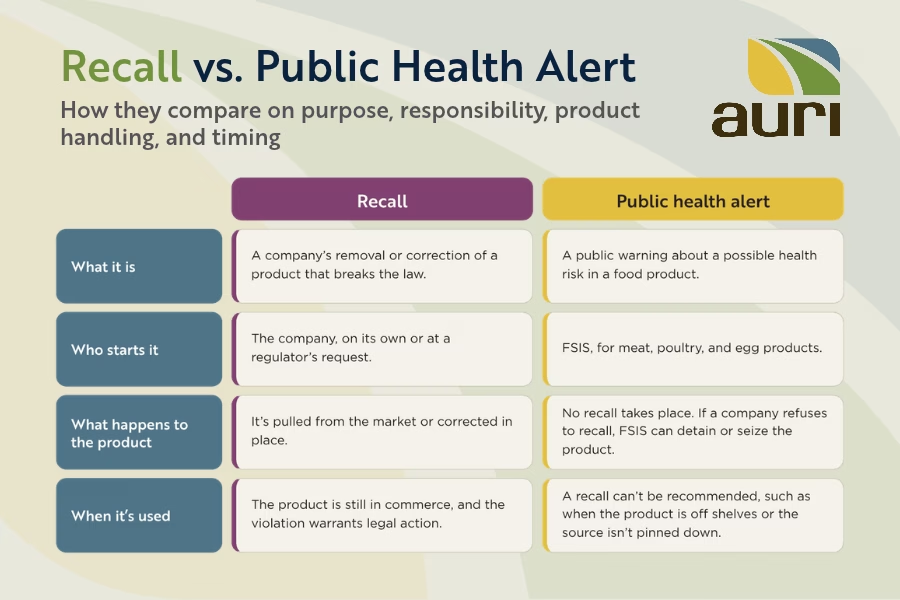
An alert includes much of the same information as a recall notice. It names the company, describes the product, explains the health risk, and tells consumers how to handle it. For food businesses, that means a product can be publicly identified even when no recall takes place. Clear lot codes and distribution records make it easier to pin down exactly which products are affected.
Who oversees food recalls in the U.S.?
Two federal agencies share responsibility for food recalls. Which one is involved depends on the product:
- The U.S. Department of Agriculture (USDA) oversees most meat, poultry, and processed egg products through its Food Safety and Inspection Service (FSIS).
- The FDA oversees most other foods, including shell eggs and game meats like venison.
States play a role, too. In Minnesota, the Minnesota Department of Agriculture helps keep food safe from production to sale and sends a weekly email listing recalls affecting the state.
What are the three classes of food recalls?
Regulators sort recalls into three classes based on how much harm the food could cause:
| Class | What it means | Example |
| Class I | There’s a reasonable probability that eating the food will cause serious health problems or death | Ready-to-eat food contaminated with a pathogen capable of causing serious illness, or a product containing an undeclared major food allergen, such as milk, that could cause a serious allergic reaction in susceptible consumers |
| Class II | The food may cause temporary or medically reversible health problems, or the chance of serious harm is remote | An undeclared, highly refined allergen unlikely to cause a reaction, such as hydrolyzed soy protein |
| Class III | The food is not likely to cause health problems | Excess water in meat or poultry products |
Why do foods get recalled?
Undeclared allergens, harmful bacteria, and foreign material show up year after year in USDA’s annual recall summaries. Here’s what each one means.
- Undeclared allergens. U.S. law requires major allergens like milk, peanuts, and wheat to be listed on the label. Leaving one off can lead to a recall.
- Pathogens. Bacteria such as Listeria, Salmonella, and E. coli can contaminate a product.
- Foreign material. Extraneous material, i.e., objects that don’t belong in the food, is a regular recall cause.
Labels are one place where a small mistake can turn into a recall. Have a question about your own product? Bring it to a free group Office Hours session on Zoom, where an AURI food scientist answers questions live. You can submit yours when you register.
Recent food recall examples
Recent recalls demonstrate how food safety problems can originate within a manufacturing operation or elsewhere in the supply chain, and why effective supplier controls, lot traceability, and recall procedures are important.
- Blackstone Parmesan Ranch Seasoning, potential Salmonella contamination: In May 2026, Blackstone Products voluntarily recalled specific lots of Parmesan Ranch seasoning after dry milk powder used by a third-party manufacturer was included in a supplier recall for potential Salmonella contamination. The affected seasoning was distributed nationwide.This example shows how an upstream ingredient issue can trigger a recall of downstream finished products. View the FDA recall notification.
- Hampton Grocer Lacnola Granola, potential Salmonella contamination: In August 2026, The Hampton Grocer recalled specific lots of Lacnola Lactation Granola after an ingredient supplier notified the company that a significant amount of Organic SuperGreens Powder Mix had tested positive for Salmonella. The implicated ingredient mix contained moringa powder that was also used to manufacture the affected granola. View the FDA recall notification.
- ByHeart Whole Nutrition Infant Formula, Clostridium botulinum: In November 2025, ByHeart initially recalled two lots of powdered infant formula following an investigation of infant botulism cases. The recall was subsequently expanded to all ByHeart Whole Nutrition infant formula products within expiry. FDA’s investigation later reported C. botulinum findings in finished product and ingredients, and FDA classified the firm-initiated recall as Class I. This case demonstrates how an emerging investigation can significantly expand the scope of a recall as epidemiological, laboratory, and traceback information develops. View the FDA outbreak and recall information.
- RAW FARM Raw Cheddar Cheese, E. coli O157:H7: In April 2026, RAW FARM issued a voluntary recall of specified lots of its raw cheddar cheese following an FDA and Center for Disease Control (CDC) investigation of a multistate outbreak of E. coli O157:H7 infections. The FDA reported that the recalled products included block and shredded raw cheddar cheese in several package sizes and date ranges. This example illustrates the importance of product identification, production coding, and distribution records when establishing and communicating the scope of a recall. View the FDA recall notification and FDA outbreak investigation.
These examples demonstrate why recall preparedness extends beyond controls within a company’s own facility. A food safety problem may originate with a supplier, ingredient, processing operation, or finished product. Effective supplier controls, ingredient and packaging lot tracking, finished-product coding, distribution records, and a documented recall plan allow a business to more quickly determine which products are affected, where they went, and what actions are necessary. Periodic mock recalls can then be used to test whether these systems and documented procedures work as intended.
What are the steps in the food recall process?
A food recall typically moves through six steps, from finding the problem to formally closing the recall. The company and the regulator work together throughout, and some steps overlap: a company doesn’t have to wait for the FDA’s review before starting a recall.
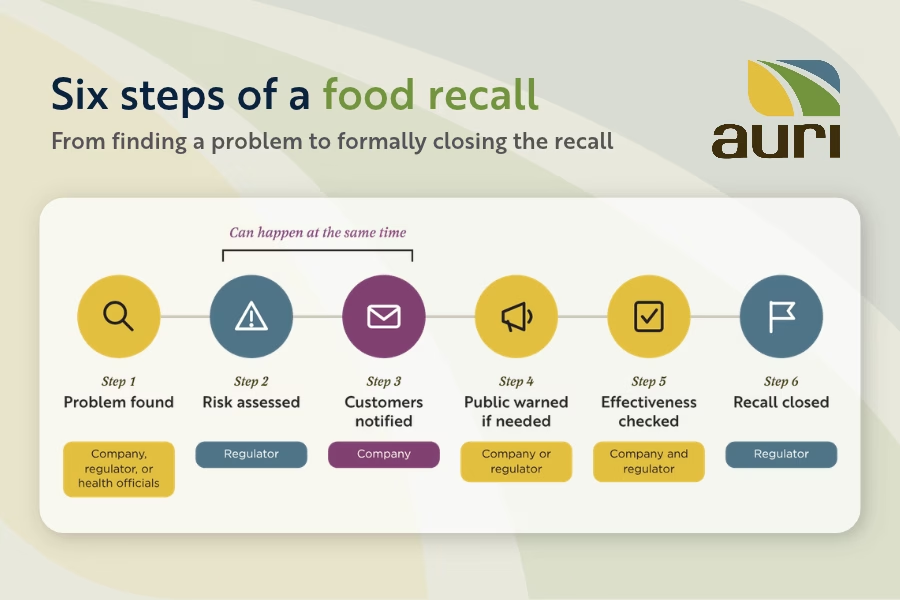
- Someone finds a problem. The discovery might come from the company itself, from government inspection and sampling, or from illness reports from public health departments.
- The hazard and scope are evaluated. The company gathers information needed to identify the affected product and evaluate the issue, while the appropriate regulatory agency evaluates the health hazard and determines the recall classification. A company does not need to wait for FDA classification before initiating a voluntary recall.
- The company notifies its customers. Distributors and retailers learn which product is affected and what to do with it.
- The public is warned when needed. For serious hazards, the company or the regulator issues a public warning.
- Effectiveness checks confirm the public warning worked. Checks verify that customers got the recall notice and took action.
- The recall is closed. The regulator ends the recall once the product has been removed from the market or corrected and properly handled.
Since January 2011, the Food Safety Modernization Act (FSMA) has allowed the FDA to order a recall when there’s a reasonable probability that a food is adulterated or misbranded because of an undeclared allergen, and could cause serious health problems or death. The FDA must first give the company a chance to recall voluntarily.
How can a food business reduce recall risk and prepare for a recall?
Preventing a food recall starts well before products ship. Businesses should have preventive controls to reduce the likelihood of a food safety or labeling problem, along with traceability and recall procedures that allow them to respond quickly if one occurs.
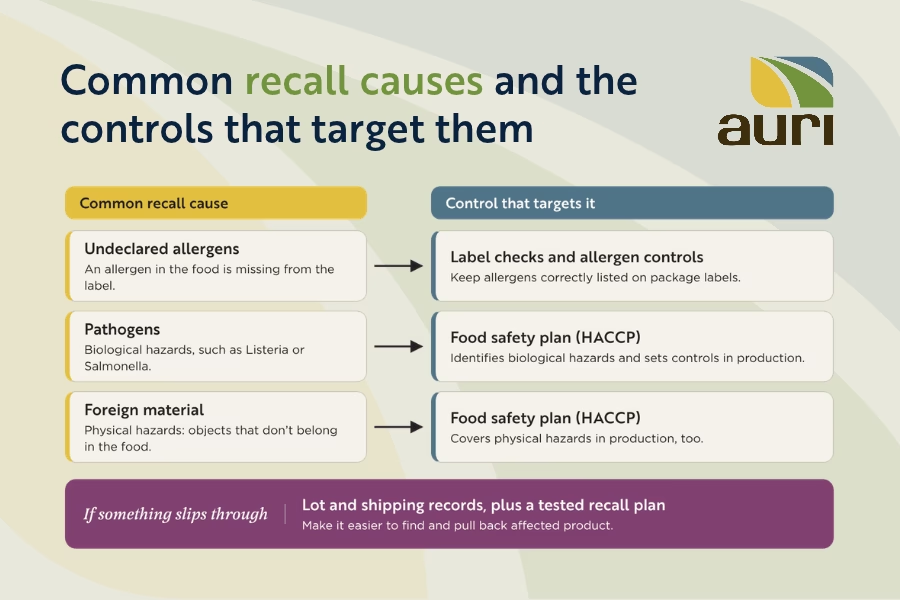
- Verify labels and allergen declarations. Establish controls to ensure the correct label is applied to the correct product and that ingredients and major food allergens are accurately declared. Label review should account for formulation and ingredient changes as well as packaging revisions.
- Build and maintain an appropriate food safety plan. Identify reasonably foreseeable biological, chemical, physical, and allergen hazards and establish appropriate preventive controls when required. Depending on the product and regulatory jurisdiction, this may involve an FDA Food Safety Modernization Act (FSMA) Preventive Controls for Human Food safety plan, Hazard Analysis and Critical Control Points (HACCP) Plan, or other required food safety system.
- Maintain documented lot traceability. Establish records and procedures that allow the business to trace ingredients and packaging materials into production lots and trace finished products forward through distribution. Lot coding, production records, ingredient and packaging lot records, and customer/distribution records should work together so the business can quickly identify the scope of potentially affected product and where it was distributed.
- Develop a written recall plan and test it. For FDA-regulated foods subject to FSMA preventive controls requirements, a written recall plan is required when a hazard requiring a preventive control is identified. The plan should clearly assign responsibilities and document procedures for identifying affected product, notifying customers and appropriate regulatory authorities, issuing public notification when necessary, conducting effectiveness checks, and controlling the disposition of recalled product. The recall plan should be supported by a documented traceability system that can identify affected production lots and determine where they were distributed. Conduct periodic mock recalls to test whether the documented procedures and records actually work in practice and use the results to correct gaps before a real event occurs.
Every food business carries its own risks, from the ingredients it sources to the way it labels and ships. If you have a question about yours or an idea you want to test, reach out to AURI’s team directly.
Talk to a Food ExpertFrequently asked questions
Recalls are generally voluntary. A company can decide on its own to remove or correct a product at any time. The FDA can also request a recall when a product poses a risk, and the company hasn’t acted. In limited cases, the FDA can order one, as explained in the step-by-step section above.
Undeclared allergens are one of the most common. In 2023, they were behind 15 of 65 USDA recalls of meat and poultry and 14 of 24 public health alerts. Careful label review is one of the simplest ways to prevent them.
Many do. Facilities covered by the FDA’s preventive controls rule need a written recall plan when their food presents a hazard that requires a preventive control. FSIS-inspected meat and poultry plants must also plan for recalls. Some smaller “qualified facilities” follow modified requirements instead, so confirm what applies to your operation.
A mock recall is a practice run of your recall plan. You pick a production lot, trace where it went, and test how quickly your recall team can reach every customer to show whether the written plan works.
Recalled food may be reprocessed, reworked, destroyed, or diverted to a use that doesn’t pose a safety risk. The recall plan should include checks that confirm the recall worked.