Information accurate as of November 2026.
- GRAS (generally recognized as safe) status means qualified experts agree a substance is safe for a specific use in food, so it doesn’t need the FDA’s premarket approval.
Read full summary ▾
- Since 1972, companies have been able to self-affirm an ingredient’s GRAS status, and notifying the FDA has been voluntary since 1997.
- The FDA’s August 2026 proposal would require pre-market notification for most GRAS uses.
- Businesses developing new ingredients or using familiar ones in new ways would feel the change most.
- No single list covers every GRAS substance, so checking an ingredient means using several FDA resources.
- It’s important to note that GRAS status for an ingredient is specific to an application of that ingredient. In other words, there is no generic GRAS status for an ingredient; rather, there are GRAS applications for specific ingredients.
This article explains how GRAS works, what the FDA’s proposed rule would change, and when new requirements could begin. It also covers where to check an ingredient’s status and the steps food businesses can take as the rulemaking moves forward.
Generally recognized as safe, or GRAS, status determines whether an ingredient needs approval from the U.S. Food and Drug Administration (FDA) before it goes into food.
In 1972, the FDA established the GRAS affirmation process, through which companies could petition the agency to review and affirm an ingredient’s GRAS status. However, companies could also independently determine whether an ingredient qualified as GRAS without seeking FDA affirmation. In 1997, the FDA proposed replacing petitions with a voluntary notice program in which companies could choose to share their GRAS conclusions. In 2016, the agency finalized this program in regulations, clarifying the criteria for GRAS status and formalizing the voluntary notification procedure.
In August 2026, the FDA proposed a rule that would make those notices mandatory. If it’s finalized, companies would need to notify the FDA about most GRAS uses, including ingredients already on the market.
In this article, we’ll go over the following:
- What is Generally Recognized as Safe (GRAS)?
- What is the FDA’s proposed GRAS rule?
- When would the changes take effect?
- Which food businesses would the proposed rule affect?
- Is there an official GRAS list?
- How can food businesses prepare?
- Frequently asked questions (FAQs)
Working on a new ingredient or food product? AURI’s food team can help you think through technical and regulatory questions early.
What is Generally Recognized as Safe (GRAS)?
Generally recognized as safe (GRAS) describes a substance added to food that qualified experts agree is safe under its intended conditions of use. GRAS substances fall outside the legal definition of a food additive, so they don’t need the FDA’s premarket approval.
Congress created the GRAS category in the 1958 Food Additives Amendment. The law required FDA approval for new food additives but excluded substances that experts recognized as safe.
There are two ways to establish GRAS status:
- Scientific procedures. Experts rely on generally available data, usually published studies, to conclude the use is safe.
- Common use in food before 1958. A substance used in food before January 1, 1958, can qualify if it has a substantial history of consumption by many people.
GRAS vs. food additive approval
A GRAS conclusion based on science needs the same quantity and quality of evidence as a food additive approval. What differs is who reaches the conclusion. For a food additive, the FDA itself decides on safety. For GRAS conclusions, qualified experts outside the government can make the call.
What is the FDA’s proposed GRAS rule?
On August 11, 2026, the FDA published a proposed rule that would require anyone selling a substance as GRAS to notify the agency of the basis for that conclusion, unless an exception applies. It covers both human and animal food.
The FDA says the goal is stronger oversight of GRAS substances. The proposal argues that more information would help the agency spot unapproved food additives and potentially unsafe substances sooner. It also describes cases in which the FDA learned about a problem ingredient only after products had reached consumers.
What would change under the proposed rule?
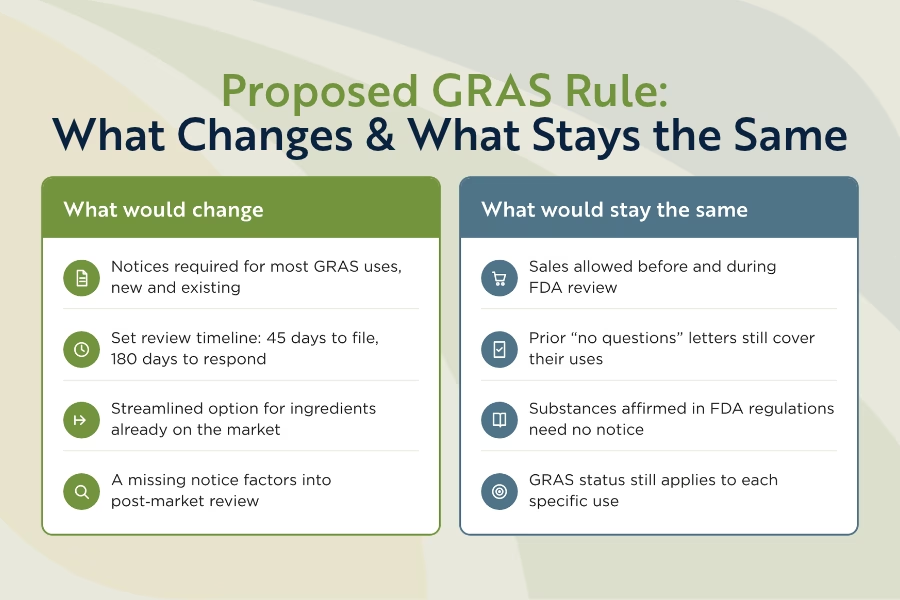
Under the proposal, most GRAS uses, new and existing, would need to be reported to the FDA, which would review them on a set timeline. The rule would add a premarket notification step, not a premarket approval, so companies could continue selling while the review is underway.
What would change
- Anyone selling a substance as GRAS would need to notify the FDA, unless an exception applies.
- The FDA would have 45 days to decide whether to file a submission, then 180 days to respond. It could extend that period twice, by up to 90 days each time.
- Companies already selling a self-affirmed GRAS ingredient before the rule takes effect could file a shorter, streamlined submission in place of a full notice.
- The FDA would treat a missing notice as a factor when choosing which substances to review after they reach the market.
What would stay the same
- Companies could sell an ingredient before filing a notice and while the FDA reviews it.
- A use already covered by an FDA “no questions” letter wouldn’t need a new notice, even if another company filed the original.
- Substances the FDA has affirmed as GRAS in its regulations wouldn’t need a notice.
- GRAS status would still attach to a specific use, so a new food, level, or purpose may require its own analysis.
When would the changes take effect?
Nothing changes yet. Public comments on the proposal close December 9, 2026. The FDA would then review the comments and decide whether to issue a final rule and, if so, in what form.
If the FDA finalizes the rule as currently proposed, the timeline would look like this:
- Final rule published: No date set
- 60 days after publication: Rule takes effect
- 1 year after the effective date: Streamlined submission window closes
- 18 months after the effective date: Mandatory notices required
The final rule may differ from the proposal, so this timeline may change.
Want to keep up with AURI’s latest projects, events, and articles? Sign up for the Ag Innovation News e-newsletter. It comes out once a month and takes just a minute or two to read.
Which food businesses would the proposed rule affect?
The rule would mainly affect companies that sell, or plan to sell, ingredients based on a self-affirmed GRAS conclusion. That includes developers of new ingredients and companies using familiar ingredients in new ways.

More likely to be affected are:
- Businesses developing new or less common food ingredients
- Companies using a familiar ingredient in a new food, at a new level, or for a new purpose
- Ingredient suppliers that have self-affirmed GRAS status without notifying the FDA
Less likely to be affected include:
- Uses already covered by an FDA “no questions” letter
- Substances the FDA has affirmed as GRAS in its regulations
Is there an official GRAS list?
Not a complete one. The FDA’s regulations say its GRAS listings don’t include every GRAS substance, and self-affirmed conclusions don’t have to be reported.
The “GRAS list” refers to the list the FDA first published in 1958, which now appears in 21 CFR Parts 182, 184, and 186. Many substances the food industry considered GRAS never made it onto that list. To check an ingredient, look across these FDA resources:
- GRAS Notice Inventory: every filed notice and FDA’s response
- Select Committee on GRAS Substances (SCOGS) database: scientific reviews of GRAS substances from 1972 to 1980
- 21 CFR Part 182: substances listed as GRAS in food
- 21 CFR Part 184: substances the FDA has affirmed as GRAS, some with limits on use
- The FDA’s partial lists of microbial-derived food ingredients and enzyme preparations
How can food businesses prepare?
Determine which of your ingredients rely on GRAS status and how that status was established. Then keep track of where the rulemaking stands.
- List your GRAS ingredients. Note each one’s food category, use level, and purpose.
- Check the FDA’s resources. Look for a matching notice, listing, or affirmation for each specific use.
- Talk to your suppliers. Ask how they established GRAS status and whether they notified the FDA.
- Plan for regulatory time. Build it into new product timelines and development budgets, especially for new ingredients.
- Comment if you’d like. Anyone can submit a public comment on docket FDA-2025-N-3262 through December 9, 2026.
AURI’s food scientists and business development staff work through technical and commercial questions together. That can include product development, food safety, labeling, and general regulatory guidance. Reach out to start the conversation.
Contact AURIFrequently asked questions (FAQs)
No. The FDA doesn’t approve GRAS substances, and its response to a GRAS notice isn’t an approval either. A “no questions” letter means the FDA didn’t question the company’s conclusion. The proposed rule wouldn’t change this.
No. It’s a proposal, and public comments are open through December 9, 2026. If the FDA issues a final rule, it would take effect 60 days after publication, and mandatory notices would be required 18 months after that.
Under the proposal, a use covered by an FDA “no questions” letter wouldn’t need a new notice, even if another company filed it. Your use needs to match the conditions in that notice, including the food, the level, and the purpose.
Yes. The FDA can revisit a substance’s status when new safety information emerges. Partially hydrogenated oils, the main dietary source of artificial trans fat in processed foods, lost GRAS status in 2015.
Yes. The FDA’s GRAS rules for animal food sit in 21 CFR Part 570, and the proposal would amend them along with the human food rules.