Project Manager
With decades of experience providing technical and business assistance to food entrepreneurs and businesses, AURI’s food team leads a path to growth.
The food and beverage sector is experiencing growth and expansion to meet increasing demand for new and innovative products.
This trend is fueled by a combination of factors, including consumer preferences for high-quality, sustainable, local, ethically sourced, and nutritious/healthy foods, as well as a supportive business environment and access to resources for entrepreneurs.
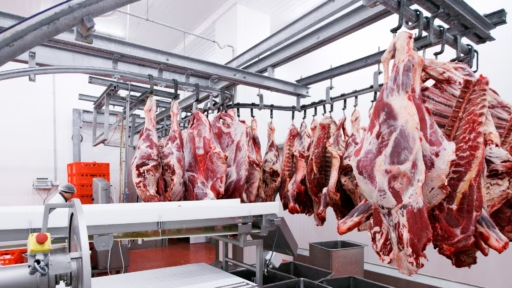
From craft breweries, distilleries, and local and regional meat processors to specialty food producers and artisan bakeries, companies across the state are capitalizing on Minnesota’s rich agricultural heritage and culinary traditions to create unique and innovative products that resonate with consumers. Minnesota is known for its robust community of small and very small meat processors.
The scaling food and beverage sector is loosely defined as emerging or startup businesses ($100,000 – $10 million) and maturing businesses ($10 million – $100 million). Scaling from local to regional to national distribution, these businesses drive economic development and job creation, particularly in rural communities where agriculture and food processing play a significant role in the local economy.
Benefits of Working with AURI:
AURI supports growth-stage companies in scaling their businesses. Technical development and commercial viability are inseparable, and AURI addresses both as parts of the same problem of scaling opportunities. AURI has decades of practical commercial experience to support decision-making and share know-how from recipe adaptation, automation, distribution, and retail requirements.
AURI’s Food scientists are available to provide consulting and technical services in the areas of product and process development, product evaluation and testing, sourcing materials, equipment and services









We publish a number of helpful guides for frequently encountered problems. Browse through the available guides below.
Whether you’re developing a new food ingredient, scaling production, or preparing for growth, finding the right support can be challenging. The Agricultural Utilization Research Institute (AURI) highlights how we provide…
Below is an overview of Agricultural Utilization Research Institute (AURI) Virtual Office Hours. This overview highlights common challenges faced by food and beverage businesses, as well as the practical technical…
Welcome to the AURI Contract Manufacturing Toolkit Scaling your food product manufacturing with a contract manufacturer can accelerate growth, but it also introduces important responsibilities and risks that every brand…
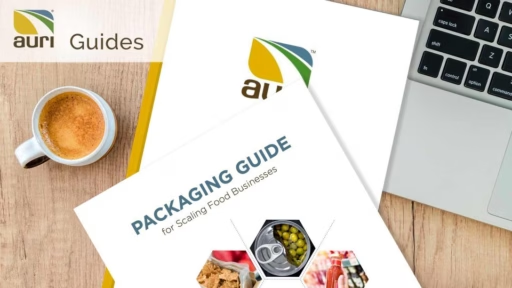
Starting or growing a food business can be overwhelming, but clear, focused guidance can make all the difference. That’s why the Agricultural Utilization Research Institute (AURI) created its Food Team…
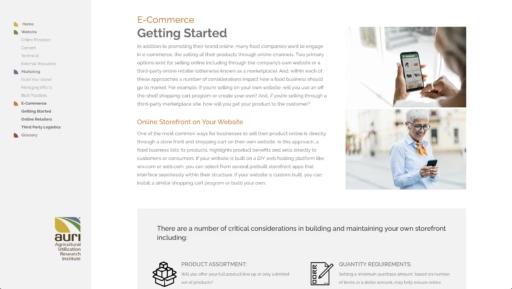
This self-guided module seeks to demystify e-commerce and digital marketing for Minnesota’s food businesses, providing both fundamental information and considerations for the scaling food business as they consider how to build their brand’s online presence.
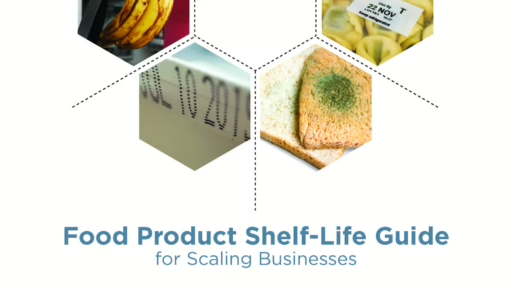
As food businesses scale from local to regional or national distribution, decisions around packaging, formulation and production are inevitable as each affects a product’s shelf life. Addressing a product’s shelf life is a common stumbling block for food businesses. The following guide helps food businesses understand the basics of product shelf life, impacting factors, an introduction to testing and business implications of shelf life decisions.
This new guide from AURI is a resource designed to help entrepreneurs and food businesses navigate these considerations and make the best decisions for their individual situations. To learn more, download the full guide and view the accompanying video.
AURI has produced a free Clean Label Guide that provides important information to help small- and medium-sized Minnesota food producers make the transition to product ingredients that make for a “clean label.”
AURI’s laboratories are available to clients for hands-on testing and development.
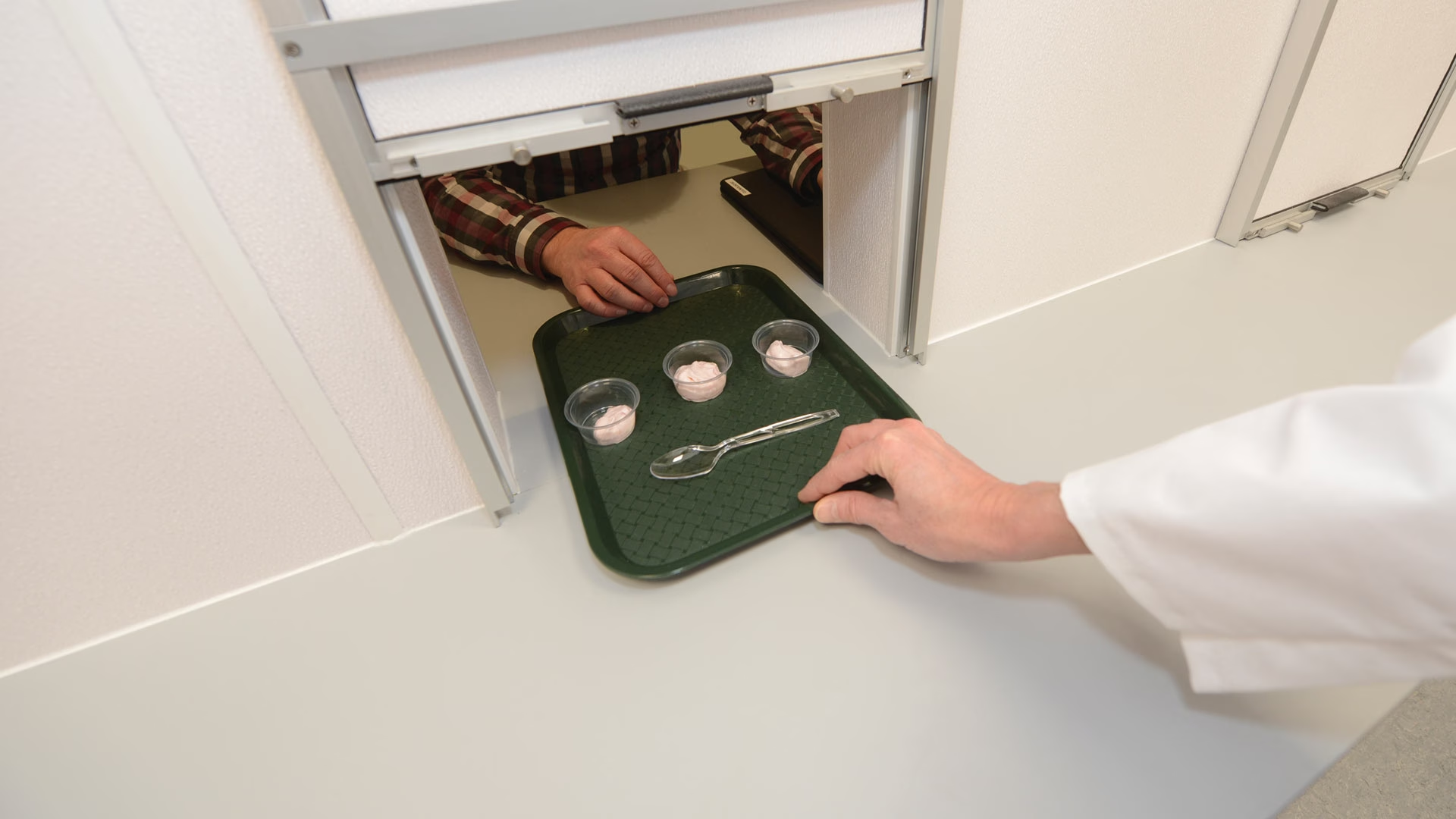
This laboratory is used to perform wet chemistry syntheses and small-scale process development.
This laboratory is focused on characterization and discovery work.
AURI does not directly offer process authority review. However, AURI scientists can get you started by assessing your current process for food safety compliance and product categorization. If a process authority is needed (for example, if you have an acidified product), we can direct you to the appropriate process authority resources.
A general confidentiality agreement is included in the application for an AURI project. If food clients at the 20 and 33 percent cost-share levels would like a specific non-disclosure agreement (NDA), they will be asked to use AURI’s attorney approved NDA. This will save time and allow AURI to quickly begin work. Note that the term of the AURI confidentiality agreement and NDA are set at 3 years, allowing a client ample time to protect any intellectual property created. Rest assured, though, that any intellectual property and trade secrets are confidential and will not be shared at any time.
AURI is a nonprofit organization with a desire to see clients succeed and move forward. As we are funded primarily by the state of Minnesota, AURI is required to report outcomes and impacts to the state legislature. Your basic company information may be used to supplement our annual reporting to the state of Minnesota. (Confidential information such as recipe, process, and marketing plans would, of course, be exempted from this reporting requirement). In general, we take our lead from the client regarding what can be shared (public use details and anything you would share publicly through your own website, promos, or articles).
AURI is a nonprofit organization with a desire to see clients succeed and move forward. As we are funded primarily by the state of Minnesota, AURI is required to report outcomes and impacts to the state legislature. Your basic company information may be used to supplement our annual reporting to the state of Minnesota. (Confidential information such as recipe, process, and marketing plans would, of course, be exempted from this reporting requirement). In general, we take our lead from the client regarding what can be shared (public use details and anything you would share publicly through your own website, promos, or articles).
If you feel you’re ready to begin a project, we’ll look at the feasibility of the project. You may begin the process by watching our ‘How-to” video and completing AURI’s food contact form, here.
Note: AURI’s food lab is neither A2LA nor ISO certified. As such, the data we generate cannot be used to validate federally-regulated on-pack claims, such as “Good source of protein.” It can, however, be used to provide guidance during development of such products. Additionally, AURI cannot use analytical analyses to calculate a Nutrition Facts label given the limited capability and capacity to analyze for all required nutrients.
For certified lab results or label claims see:
Medallion Labs: https://www.medallionlabs.com/our-services/
Minnesota Valley Testing Laboratories: http://www.mvtl.com/Services/FoodScience
AURI offers lab analyses for food components. Services include % fat, protein, moisture, ash, and carbohydrates, total sugars, mineral analysis (proximate analysis). If necessary, these analyses may confirm AURI’s nutrition calculations for nutrition facts labels.
In addition to the proximate analysis, other analytical services include: alcohol, caffeine, amino acid, and fatty acids. AURI is continually updating its analytical abilities and if an analytical service is not listed, we invite you to contact AURI to discuss your needs.
Note: AURI’s food lab is neither A2LA nor ISO certified. As such, the data we generate cannot be used to validate federally-regulated on-pack claims, such as “Good source of protein.” It can, however, be used to provide guidance during development of such products. Additionally, AURI cannot use analytical analyses to calculate a Nutrition Facts label given the limited capability and capacity to analyze for all required nutrients.
For certified lab results or label claims see:
• Medallion Labs
• Minnesota Valley Testing Laboratories
• Market Fresh Food Testing Laboratory
Clients can work one-on-one with AURI’s food scientists in our food development kitchen to review and/or reformulate products or processes (the development kitchen is located in AURI’s Marshall, MN facility). In keeping with the AURI mission, our technical and business development staff can provide guidance and suggest connections to available local ingredient sources. However, AURI does not provide complete concept to commercialization food product development services.
AURI’s analytical lab can test for Aw, % moisture, pH, and basic microbiological counts, including Total Plate Count, Total Coliform Bacteria, and Total Yeast and Mold spores. Results will assist us in assessing the stability and potential shelf life of the product.
Note: AURI does not test for human pathogens, e.g., E.coli, salmonella, listeria, etc. For these tests, contact information to relevant labs such as:
Market Fresh Food Testing Laboratory: http://www.marketfreshlabs.com/
AURI scientists provide nutrition fact labels based on calculated values. The nutrient values are based on compiled data on ingredient nutrition from a number of databases including the USDA National database. The nutrition facts labels are generally quite accurate given the large pool of data housed in these databases. Occasionally we may also use lab analyses to confirm some of the calculated values (for example, sodium content).
Operators of retail food establishments may be interested in a fact sheet on food labeling from the Minnesota Department of Agriculture.
Note: AURI’s food lab is neither A2LA nor ISO certified. As such, the data we generate cannot be used to validate federally-regulated on-pack claims, such as “Good source of protein.” It can, however, be used to provide guidance during development of such products. Additionally, AURI cannot use analytical analyses to calculate a Nutrition Facts label given the limited capability and capacity to analyze for all required nutrients.
For certified lab results or label claims see:
Medallion Labs: https://www.medallionlabs.com/our-services/
RTech Labs: https://www.rtechlabs.com/rtechlabs/media/Others/Pricelist-2017-rtech-booklet_4.pdf
Minnesota Valley Testing Laboratories: http://www.mvtl.com/Services/FoodScience
AURI can review your recipe and help you convert it into a formula, when necessary. The process of converting a formula includes measuring the weight of each ingredient and calculating percentages to get a total formula weight of 100%. This would be the first step in standardizing the recipe.
Scaling up a recipe for standardized production varies greatly depending on the product and process. An AURI scientist will review the information and provide guidance on production options (e.g., commercial kitchen, co-packer or your production space).
Once you have determined your production scale, it is essential to document the “how” related to making your product. The purpose of this documentation is to provide a “how to” guide that will ensure product consistency from both a consumer experience (taste, texture) and food safety perspective.
AURI technical staff can provide general guidance and assistance in navigating food regulations. Some examples of regulation guidance and assistance include general safety, labeling, licenses, and inspections. AURI will work with you to provide business and product guidance specific to your needs that help further your goals.
Regulatory Websites:
FDA: https://www.fda.gov/Food/GuidanceRegulation/default.htm
USDA: https://www.fsis.usda.gov/wps/portal/fsis/topics/regulations
MDA: https://www.mda.state.mn.us/food/safety/food-safety-resources.aspx
Licensing: http://www.health.state.mn.us/divs/eh/food/license/
A product’s shelf life can best be described as the amount of time, under typical storage conditions, a product can:
A product’s shelf life should represent the shorter of the above two components.
AURI can provide excellent guidance and guidelines on defining your product’s shelf life, but does not have the capability to definitively determine. Because a product’s shelf life is both difficult and time consuming to define, please contact us to discuss your individual project goals.
Once you have initiated a project and received confirmation on the next steps regarding your project from AURI’s Program Specialist, you’ll be asked to complete the Nutritional Panel Request form if the project includes one or more of these services:
Review and/or reformulate products or processes
Nutrition facts label
Recipe
Review
Conversion
Reformulation
Scale up
Standardization
Information needed to prepare the form include product name, formula or recipe, preparation method, thermal process or cook method, serving size, weight of one serving, net weight of total sell unit, product detail and claims or comments. This information helps us determine the ingredients and equipment needed to plan your lab development work.