- Biobased products added $489 billion to the U.S. economy in 2021, showing real opportunity for new agricultural products, but a market that size doesn’t guarantee any single new idea will succeed.
Read full summary ▾
- More than 630 U.S. farms have already invested in biogas capture systems, and a feasibility study is how that kind of investment gets tested before the money is spent.
- Investment in U.S. landfill gas facilities alone has reached nearly $15 billion, a reminder of how much money is on the line before a project ever breaks ground.
- McKinsey research finds that more than half of new product launches fail to hit their business targets, often due to inadequate market assessment, exactly the gap a feasibility study is built to close.
- AURI pairs feasibility and techno-economic assessments with hands-on pilot-scale testing, so Minnesota entrepreneurs get real answers before they invest, not just a spreadsheet.
This article breaks down what a business feasibility study actually involves, how it’s different from a business plan, and what it needs to cover when your idea is built around agricultural feedstocks, biomass, or coproducts. You’ll also see how AURI pairs feasibility work with real pilot-scale testing, so you can get actionable data before committing capital to your idea.
Biobased products alone added $489 billion to the economy in 2021, and that’s just one slice of the bioindustrial space. That scale means opportunity for a new biobased, biogas, or coproduct idea, but it also means you’re not the only one chasing it. The question isn’t whether the market exists, but whether your specific idea can capture a piece of it. That’s a question a feasibility study is designed to answer.
This article explains what a business feasibility study is, how it differs from a business plan, what it should cover for a biobased, biogas, or coproduct concept, and how AURI helps you test your ideas before you invest in them.
We’ll discuss the following:
- What is a Business Feasibility Study?
- Feasibility Study vs. Business Plan: What’s the Difference?
- What Should a Feasibility Study Cover for a Biobased, Biogas, or Coproduct Idea?
- When Should Bioindustrial Businesses Do a Feasibility Study?
- How AURI Helps Test Feasibility for Bioindustrial Product Ideas
- Frequently Asked Questions (FAQs)
If you’re weighing a biobased, biogas, or coproduct idea, AURI’s Bioindustrial Team can help you test it at pilot scale before you commit capital to it.
What is a Business Feasibility Study?
A business feasibility study is a structured look at viability that answers one question: should you move forward with this business idea? It looks at the market, the cost to produce and deliver the product, and the risks involved, then tells you whether the projected revenue can cover the cost of getting there.
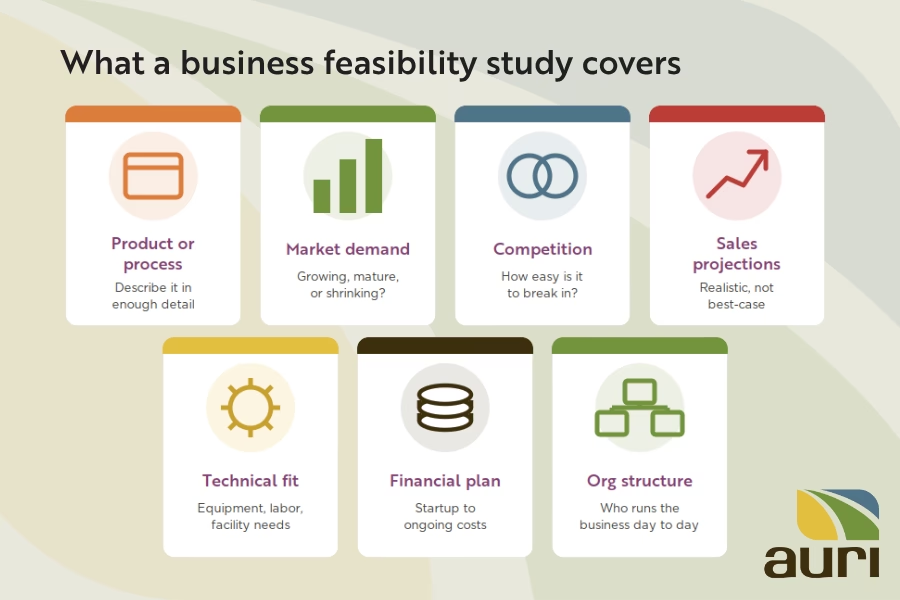
A feasibility study pulls in verified data. Drawing on the structure Iowa State’s Ag Decision Maker outlines, that typically means:
- Describing the product or process in enough detail to evaluate it seriously
- Sizing up market demand, including whether it’s a growing, mature, or shrinking segment
- Analyzing competitors and how easy or hard it is for new entrants to break into the market
- Estimating realistic sales projections, not best-case guesses
- Assessing technical and site requirements, including equipment, labor, and facility needs
- Building out financial projections, from startup costs through ongoing operating expenses
- Examining the organizational structure needed to actually run the business
Simply put, it’s an investigative step. McKinsey research shows that more than half of new launches fail to hit their business targets, and inadequate market assessment is consistently cited as a top reason. A feasibility study’s purpose is to provide an unbiased answer, one that may recommend against moving forward as easily as it may recommend getting started.
Feasibility Study vs. Business Plan: What’s the Difference?
A feasibility study and a business plan aren’t the same document. A feasibility study looks at multiple possible scenarios before you commit to one, while a business plan comes after and lays out how you’ll execute the scenario you’ve chosen.
| Feasibility Study | Business Plan | |
|---|---|---|
| Purpose | Tests whether the idea works | Details how to execute the idea |
| Timing | Before committing to one path | After you’ve chosen a path |
| Scope | Compares several options or scenarios | Focuses on a single approach |
| Audience | You and your team are making the go/no-go call | Lenders, investors, partners |
What Should a Feasibility Study Cover For a Biobased, Biogas, or Coproduct Idea?
For a bioindustrial concept, a feasibility study needs to go beyond generic market research. It has to account for the physical realities of working with agricultural feedstocks, biomass, and coproduct streams, since those don’t behave like typical raw materials.
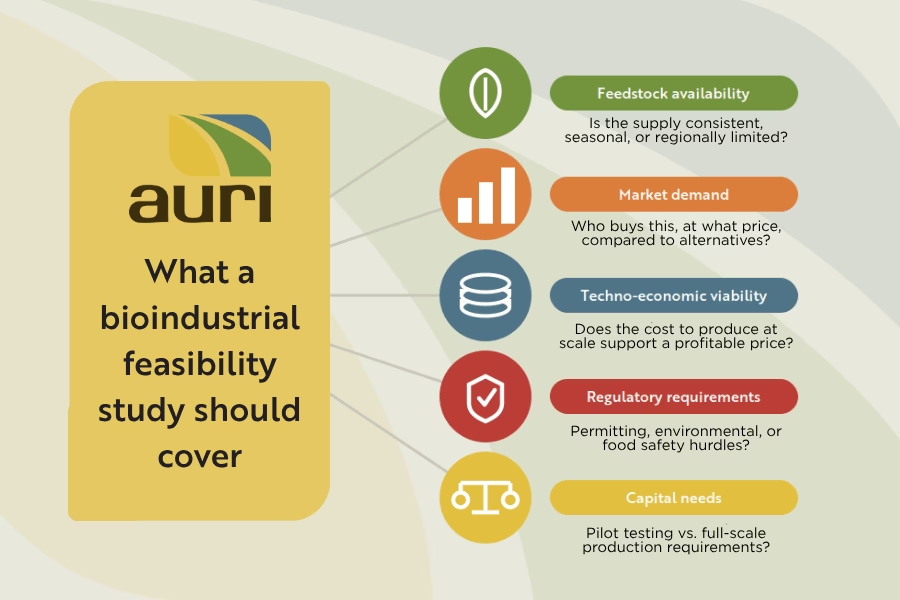
At minimum, it should cover:
- Feedstock availability: Is the supply consistent, seasonal, or regionally limited? Can you secure enough volume year-round?
- Market demand: Who buys this, and at what price? For example, a biobased material aiming to replace a petroleum-based product also needs to price itself directly against that incumbent product.
- Techno-economic viability: What will it cost to produce at scale, and does that cost structure support a profitable price point?
- Regulatory requirements: Are there permitting, environmental, or food safety hurdles specific to this feedstock or process?
- Capital needs: What’s required for pilot testing versus full-scale production, and where’s the risk if either step comes up short?
This list reflects the same categories AURI’s Bioindustrial team works through with clients, from feedstock and market feasibility to techno-economic and capital planning.
Common Feasibility Study Gaps in Bioindustrial Products
A biobased material might have plenty of demand but an unworkable cost structure, the exact tension AURI’s biobased products team works through with clients. A biogas project might have strong numbers on paper, but still depend on consistent feedstock volume, handling logistics, and operating assumptions. With hundreds of U.S. farms already operating biogas capture systems, feasibility work helps producers evaluate those realities before committing capital.
Capital and Regulatory Risk
Committing to equipment or infrastructure before an idea is fully vetted carries financial and regulatory risk. A bench-top trial costs far less than a dedicated biogas digester or a new processing line, so capital needs should scale with how far along the idea actually is. Regulatory requirements add another layer of risk.
For example, a business exploring RNG would need to understand all applicable federal, state, utility, and permitting requirements before investing in project infrastructure.
AURI in Action: A Biobased Feasibility Case Study
When customers asked Minnesota company Clean Plus, Inc. (CPI) for a granular version of its existing biobased absorbent pad, CPI ran feasibility studies with AURI and the University of Minnesota-Duluth to determine a viable production process. That work pointed them toward a method similar to how taconite pellets are made, and CPI invested in large-scale equipment built around it. AURI Senior Scientist Alan Doering also worked with CPI on developing the proof of concept for the granular process.
As is common when scaling a new process, CPI refined its approach along the way, engineering its own system to reach full production. The feasibility study gave CPI a solid starting point to build from, and that foundation carried them to the decisions that got the product to market. Today, the resulting product, Drip Trap® Granules, is USDA-certified biobased and was the runner-up for the 2018 World Bio Markets Biobased Product of the Year.
Feasibility studies, techno-economic assessments, and new bioindustrial opportunities move fast. AURI’s Ag Innovation E-Newsletter covers new research, client stories, and upcoming events as they happen.
When Should Bioindustrial Businesses Do a Feasibility Study?
Generally, it’s best to run a feasibility study after you’ve done initial concept work but before you commit capital to pilot equipment, processing infrastructure, or scale-up. That’s the window where you know enough to test the idea seriously, but haven’t yet spent the money a wrong answer would potentially waste.
A Feasibility Study Comes After You’ve Defined Your Idea
As a prerequisite, you need a defined set of alternatives to compare and enough initial investigation to know the idea has real potential before a feasibility study is worth running. If you’re not there yet, AURI’s Getting Started resources are a good place to work out the basics first.
A Feasibility Study Comes Before You Commit Capital
This is the core of the timing question. Once you’ve committed to pilot equipment, processing infrastructure, or a build-out, the cost of being wrong climbs fast. Capital-intensive RNG projects show how quickly financial exposure can grow once infrastructure is built. For example, the ABC estimates that investment in U.S. landfill gas facilities has reached nearly $14.9 billion. A feasibility study is what you run while you can still change direction without absorbing that kind of loss.
A Feasibility Study Comes Before You Scale
Even after a successful pilot, scaling up carries its own risk, and it helps to know where the broader industry already stands. Feasibility studies draw on real data like the EPA’s AgSTAR program (which tracks how many agricultural digesters are currently operating versus under construction), giving you a real benchmark for how proven or unproven a given approach is at scale before you commit to it yourself.
How AURI Helps Test Feasibility for Bioindustrial Product Ideas
AURI pairs business feasibility and techno-economic assessments with pilot-scale testing, so entrepreneurs get an answer grounded in actual production data. Much of that hands-on work happens across AURI’s laboratory and pilot-scale facilities, including the Bioindustrial Innovation Center in Waseca and the analytical chemistry lab in Marshall. AURI’s scientists and business developers work side by side, translating lab results into commercial realities as the analysis happens.
That looks like:
- Techno-economic assessments that model real production costs, not generic industry averages, using data from AURI’s analytical chemistry labs
- Pilot-scale services, including pelleting, decortication, dewatering, drying, and anaerobic digestion, that measure actual yield, cost, and production speed.
- Business development support covering feedstock availability, go-to-market strategy, and financial viability, built alongside the technical work instead of being brought in once the science is finished
- Public-domain applied research and, where appropriate, fee-for-service support for more individualized feasibility questions.
Whether the idea is a biobased material meant to replace a petroleum-based ingredient, a biogas project built around agricultural residue, or a new use for a coproduct stream, AURI’s Bioindustrial Team can help test whether it holds up before you build around it.
You can see how this has worked for other Minnesota businesses in AURI’s success stories. For the bigger picture, AURI’s statewide impact numbers show what this work adds up to across the state.
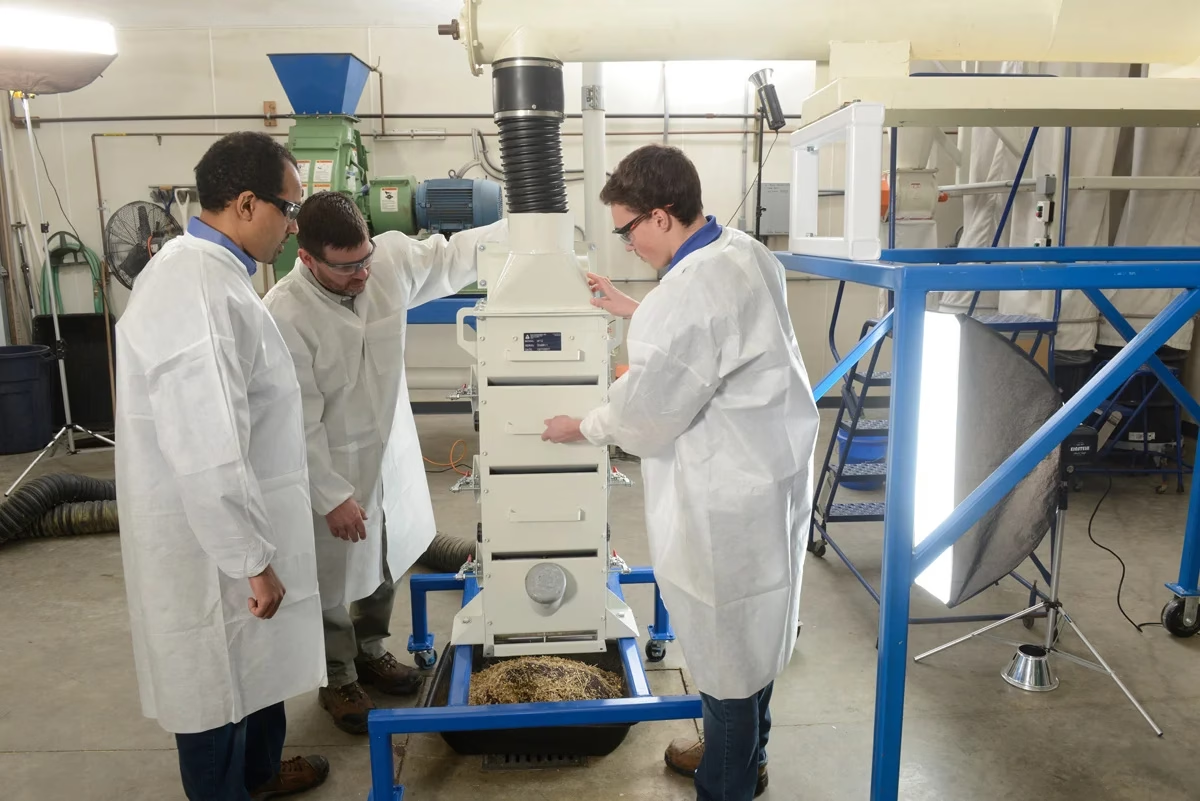
A feasibility study is how you find out whether your biobased, biogas, or coproduct idea can hold up before you invest capital in it. AURI’s Bioindustrial Team tests ideas at pilot scale, using real production data to answer the question.
Frequently Asked Questions (FAQs)
How much does a business feasibility study cost for a biobased or biogas product?
Costs depend heavily on the scope of the study, from a narrow market check to a full techno-economic assessment with pilot testing. AURI offers some feasibility and techno-economic work as part of its business development services. For a quick first read on your idea, Getting Started with AURI is a good place to start.
How long does a feasibility study take for a bioindustrial idea?
Timelines depend on how much original research and pilot testing the idea needs, especially for feedstocks or processes that haven’t been tested at scale before. AURI’s team can give you a realistic timeline once they understand the scope of your idea.
Do I need a feasibility study before writing a business plan for a coproduct venture?
Yes. A feasibility study tells you whether the venture can work at all, and a business plan assumes you’ve already answered that question. Writing a business plan first risks building a detailed roadmap around an idea that hasn’t been tested.
Can AURI help fund or conduct a feasibility study?
AURI provides feasibility and techno-economic assessment services directly, and some early-stage, public-domain research is offered at no cost. Fee-for-service work is available for more individualized support. Reach out through AURI’s contact page for specifics on your idea.
What happens if a feasibility study shows my idea isn’t feasible yet?
That’s a useful outcome, not a failure. A feasibility study that surfaces a problem, like inconsistent feedstock supply or a cost structure that doesn’t pencil out, gives you the chance to adjust the concept, target a different market, or wait for conditions to change before you invest.