- Digestate is the solid and liquid material left after anaerobic digestion. It retains nearly all the nutrients that went into the digester. But the digestion process changes their form.
Read full summary ▾
- Most digestate becomes crop fertilizer, livestock bedding, or compost. Which one depends on whether it’s separated into liquid and solids, and on whether it comes from a farm or a stand-alone digester.
- Digestate is worth the fertilizer or bedding it replaces, or whatever a buyer will pay for it. Selling digestate means proving its quality.
- Managing digestate relies on testing, matching application rates to crop needs, and timing applications to limit nitrogen loss. In Minnesota, the applicable rules depend on what went into the digester.
- The Agricultural Utilization Research Institute (AURI) offers digestate testing, separation evaluation, and market and economic analysis.
Digestate can become fertilizer, bedding, compost, or a disposal problem. Which one it becomes depends on what goes into the digester and how it’s handled afterward. Knowing what’s in your digestate is the first step to putting it to good use.
Anaerobic digestion produces two main outputs: biogas and digestate. While biogas can be used to generate energy or sold for revenue, digestate has value of its own and requires careful management. It needs to be stored, tested, and transported before it can be put to use. If you’re weighing a digester, your plan for digestate deserves as much thought as your plan for gas.
This guide explains what digestate is, the nutrients it contains, and how liquid and solid digestate differ. It also covers how digestate is used, what affects its value, how to manage it (including Minnesota’s rules), and how AURI can help with digestate testing and planning.
We’ll discuss the following:
- What is digestate?
- What nutrients are in digestate?
- What’s the difference between liquid and solid digestate?
- What is digestate used for?
- What makes digestate valuable?
- How should digestate be managed?
- How does AURI help with digestate?
- Frequently asked questions
Planning for digestate? AURI’s Bioindustrial team tests digestate for nutrients, pathogens, and contaminants, evaluates separation options, and helps you weigh the economics before you invest.
What is digestate?
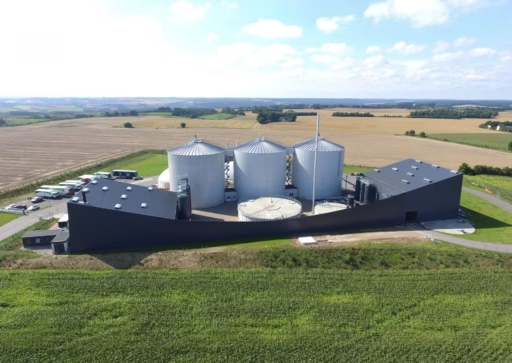
Digestate is the solid and liquid material left at the end of anaerobic digestion. Anaerobic digestion is a natural process in which microorganisms break down organic matter, like manure, food scraps, or food processing byproducts, without air. It happens inside a digester, which is a completely enclosed tank or lagoon.
As the microorganisms work, they produce biogas, a mix of mostly methane and carbon dioxide that can be used for heat, power, or fuel. Most of the remaining material, including the water and nutrients, stays behind as digestate. The U.S. Environmental Protection Agency (EPA) notes that digestate is much less odorous than the material that went into the digester. Digestion also reduces pathogens, though it doesn’t eliminate them. How much it reduces them depends on the digester’s temperature and how long material stays inside.
What nutrients are in digestate?
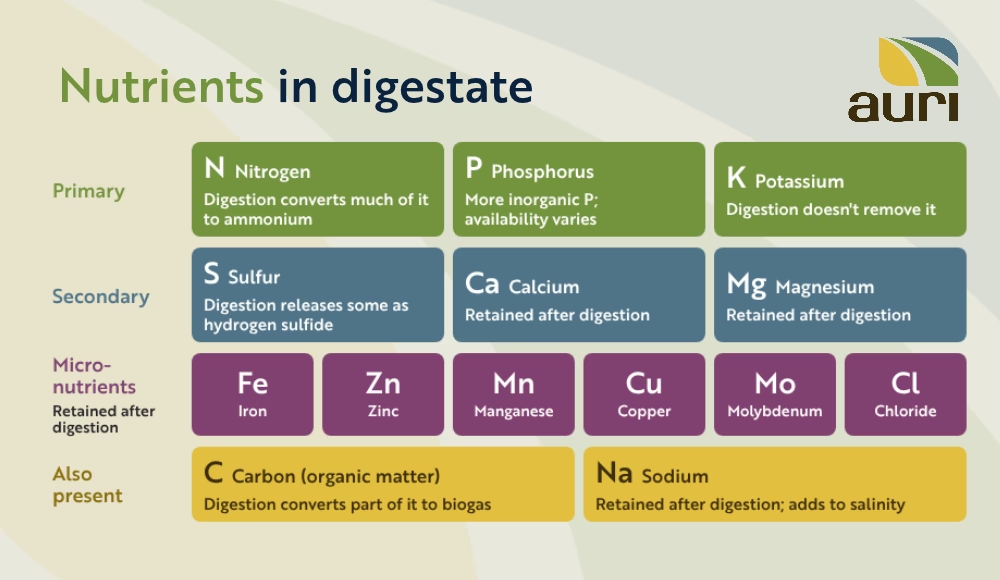
Digestate contains the nutrients that entered the digester: nitrogen, phosphorus, and potassium, as well as secondary nutrients, micronutrients, and organic matter. Digestion doesn’t reduce nutrient value or volume. What changes is the form those nutrients take, along with the material’s pH and carbon content. Those changes affect how you store, apply, and credit digestate as fertilizer.
Nitrogen
Digestion converts organic nitrogen into ammonium. Washington State University (WSU) researchers report that ammonium can account for 50 to 75 percent of the total nitrogen in digested manure. In one co-digestion study cited by WSU researchers, ammonium rose from 34 percent of total nitrogen before digestion to 58 percent after. A small amount of ammonia leaves with the biogas, but the total nitrogen coming out of a digester is generally considered equal to what went in.
Digestate also tends to have a higher pH than undigested manure. More ammonium at a higher pH makes nitrogen easier to lose as ammonia gas when digestate sits on the soil surface.
Phosphorus
Digestion doesn’t remove phosphorus. The same WSU review found that a larger share of phosphorus shifts to inorganic forms during digestion. Inorganic phosphorus is the form plants take up, according to University of Minnesota Extension, so phosphorus in digestate may become available to crops sooner. However, some of it can bind with calcium or magnesium into minerals that dissolve slowly, so availability varies by feedstock. Nutrient management plans should account for that shift and be based on test results. When digestate is separated, the solids usually hold more phosphorus per ton than the liquid. How much of the total phosphorus ends up in the solids depends on the separator, as explained below.
Potassium
Potassium isn’t lost during digestion either. University of Minnesota Extension credits 90 percent of the potassium in animal manure as available to crops in the first year. Since digestion doesn’t remove potassium, manure-based digestate brings that same supply to the field.
When digestate is separated, the liquid fraction has the higher potassium content. Minnesota’s manure testing rule only requires nitrogen and phosphorus, so ask your lab to include potassium if you plan to count it toward your fertilizer needs.
Sulfur, calcium, and magnesium
Digestate also carries secondary nutrients, though not always in the amounts crops need. Some sulfur leaves the digester as hydrogen sulfide in the biogas, and the rest stays in the digestate.
A Swedish greenhouse trial using liquid digestate from mostly food waste and manure found it didn’t supply enough sulfur for the plants’ needs. Plants fed digestate alone showed sulfur deficiency until other nutrients, including sulfur, were added. The digestate also had far more calcium than magnesium, a balance the researchers linked to lower phosphorus availability. It was a single trial on one crop, so the results point to the value of testing your digestate rather than to a general rule.
Micronutrients and salts
That same Swedish greenhouse trial found iron, zinc, manganese, copper, and molybdenum in digestate, along with sodium and chloride, which add to salinity. Metal content depends on what goes into the digester.
Organic matter and carbon
Because microbes convert part of the carbon into biogas, digestate has less organic matter and a lower carbon-to-nitrogen ratio than undigested manure. With a lower ratio, soil microbes tie up less nitrogen as they break the material down, which can leave more nitrogen for the crop. The carbon that remains tends to be the more stable fraction, which breaks down slowly. Researchers are still studying how that affects long-term soil organic matter compared with raw manure. Results can differ by soil, feedstock, and management.
What’s the difference between liquid and solid digestate?
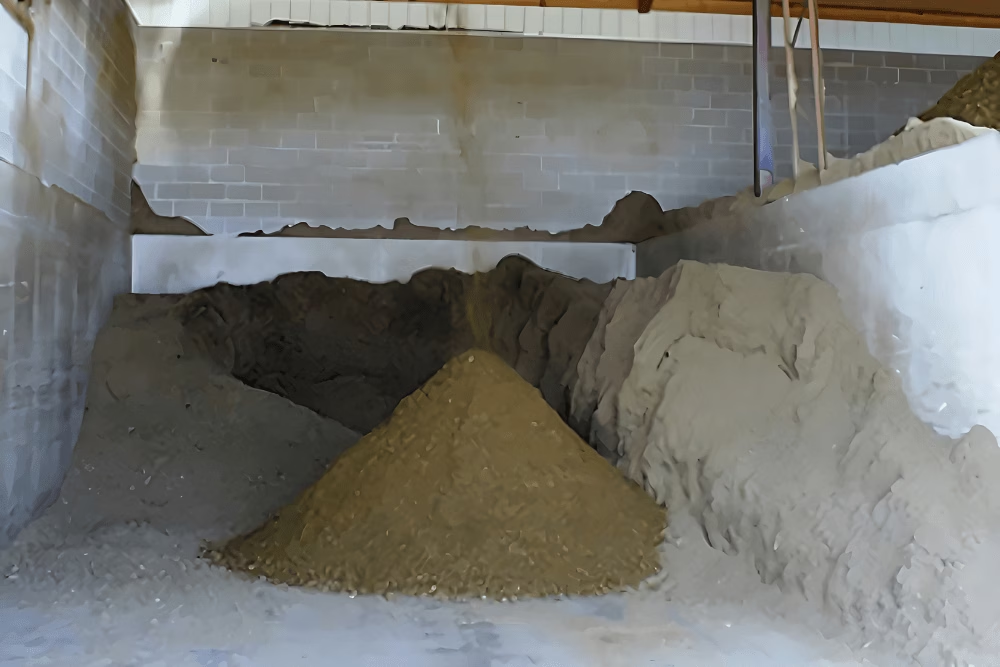
Some digesters send whole digestate through a separator, which splits it into a liquid fraction and a fibrous solid fraction. The liquid is usually land-applied as fertilizer. The solids can be spread on fields, sold, or composted for bedding.
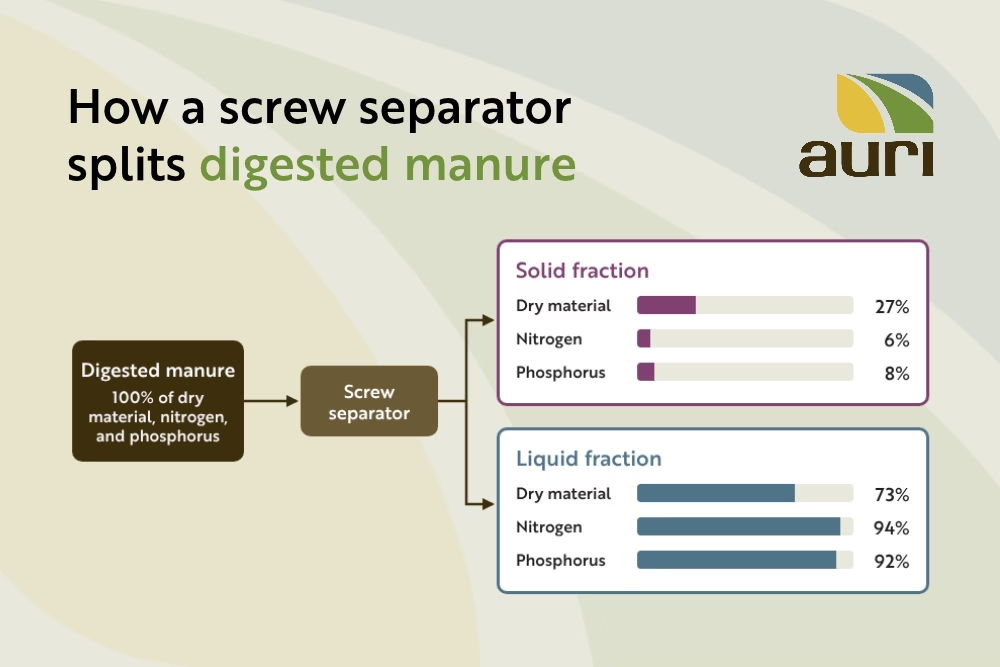
How nutrients divide between the two depends on the equipment. In preliminary Washington State University testing with a screw separator, the solid fraction captured 27 percent of the digestate’s dry material, but only 6 percent of its nitrogen and 8 percent of its phosphorus. The other 94 percent of the nitrogen and 92 percent of the phosphorus stayed in the liquid. Those results are typical of screw presses, which mainly remove coarse fiber. Centrifuges and separators that use chemical additives capture finer particles and can move a much larger share of the phosphorus into the solids. The right equipment depends on where you need the nutrients to go.
| Liquid digestate | Solid digestate | |
| What it is | The liquid left after separation; with screw presses, it holds most of the nutrients | Fibrous material pressed or screened out of whole digestate |
| Common uses | Crop fertilizer through land application | Livestock bedding, compost, soil amendment |
| Handling | Pumped and applied with liquid application equipment | Spread on fields, sold, composted, or dried |
What is digestate used for?
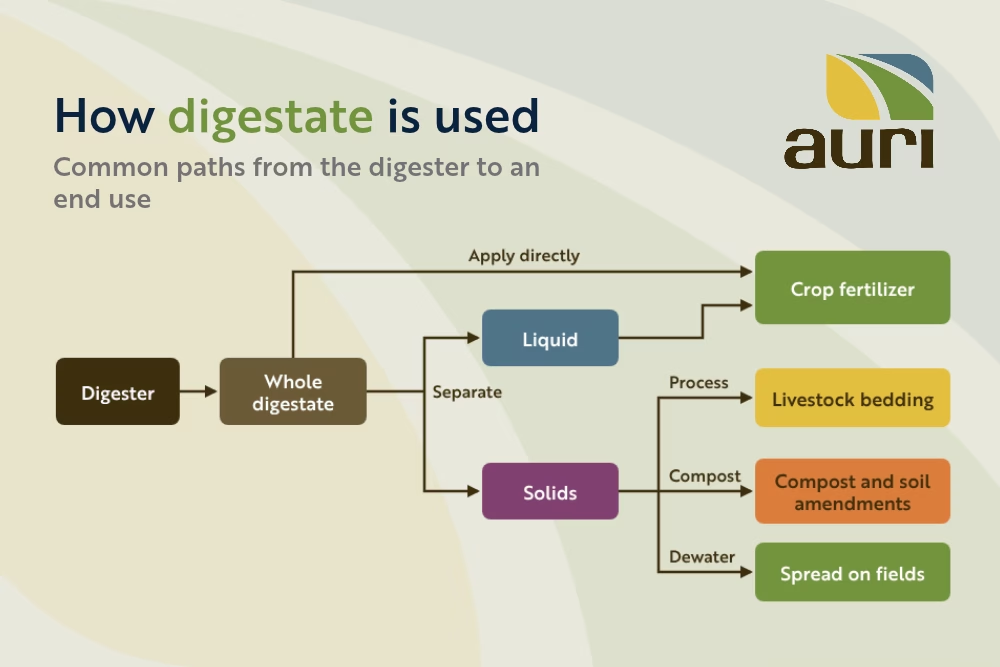
On farms and at stand-alone digesters, the most common uses are crop fertilizer, livestock bedding, and compost. EPA’s survey of digesters that accept food waste, based on 2019 data, shows how those uses vary by facility type. Only a small number of facilities responded, and the farm digesters in the survey also process food waste.
Fertilizer
On-farm and stand-alone digesters in the survey commonly reused their liquid digestate as fertilizer through land application. As a fertilizer, digested manure performs much like raw manure. In a two-year Washington State University grass study, researchers applied digested and undigested manure to grass at rates that supplied equivalent amounts of nitrogen. Both produced similar grass yields, and the grass absorbed similar amounts of nitrogen from each.
Livestock bedding
Bedding was the top use for solid digestate on farms. Of the 12 on-farm digesters reported,8 processed their solids into animal bedding. Penn State Extension cautions that bedding savings may not cover the cost of separation equipment, so a feasibility assessment belongs early in the planning process.
Compost and soil amendments
Stand-alone digesters in the survey leaned toward compost. Of the 20 that reported, 11composted their solid digestate into a reusable or salable product. Others dewatered it and spread it on land.
Choosing the right use
The survey shows a pattern: digestate usually goes to the most practical use near where it’s produced.
- On-farm digesters already have livestock and cropland. Dairies often turn their solids into bedding and apply the liquid to fields. Swine operations, which rarely use bedding, typically apply their digestate to fields.
- Stand-alone digesters aren’t attached to a farm, so they more often compost their solids into a product they can sell.
For your operation, the best fit depends on what you already have: cropland that needs nutrients, livestock that needs bedding, or a buyer for a finished product.
What makes digestate valuable?
Digestate is worth whatever it replaces or whatever a buyer will pay for it. For most farms, that means fertilizer and bedding they don’t have to buy. For digesters that sell it, value hinges on proving its quality, because digestate is harder to market than compost.
Where the value comes from:
- On your own farm: Fertilizer or bedding you don’t have to buy.
- When you sell it: Buyers want proof of quality before they’ll pay. Third-party certification, such as the American Biogas Council’s digestate standard program, gives buyers consistent test results to compare products.
What can limit its value:
- Handling costs can exceed its value. Digestate is mostly water, so storing, hauling, and applying it can cost more than its nutrients are worth, especially when fields are far from the digester.
- Harder to market than compost. EPA notes that digestate has less direct marketability than compost.
- Poor quality lowers the price. Low-quality products may be sold for lower-value uses or sent to a landfill.
- No help with extra nutrients. Digestion keeps nutrients in the material, so it doesn’t help farms that already have more nutrients than their land can use, according to Penn State Extension.
How should digestate be managed?
Treat digestate like any other nutrient source. Test it, apply it at rates that match crop needs, and time applications to limit nitrogen loss.
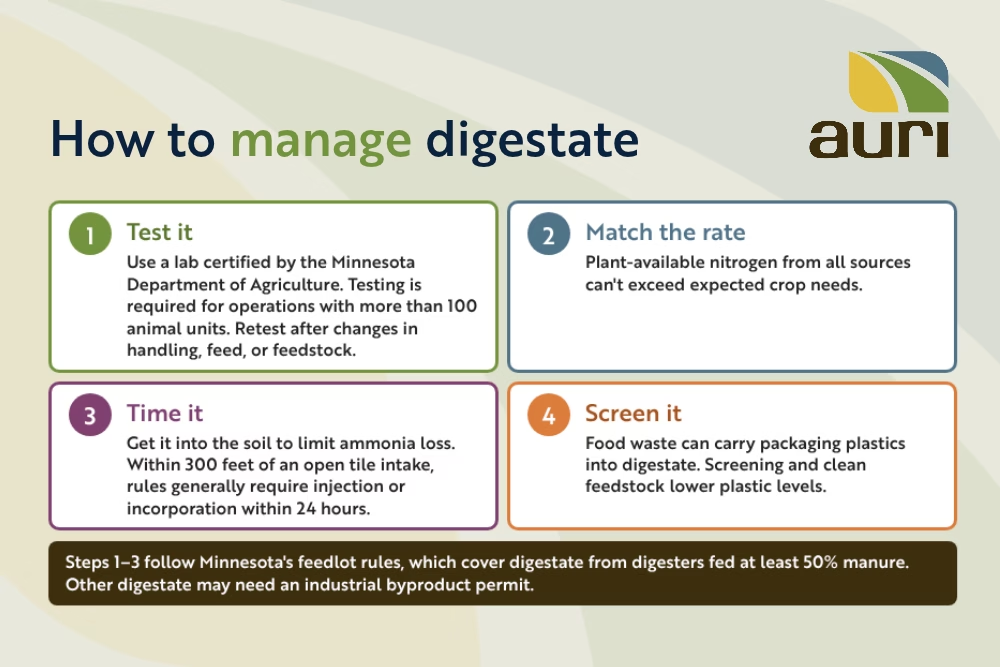
In Minnesota, the applicable rules depend on the feedstock. Digestate from manure-only digesters, or from digesters fed at least 50 percent manure, falls under the state’s feedlot rules. When a digester runs mostly on industrial byproducts, its digestate requires an industrial byproduct permit. Other feedstocks are reviewed on a case-by-case basis.
If you’re unsure which rule applies, the Minnesota Pollution Control Agency or your county feedlot officer can confirm.
Test before you apply
For manure-based digestate, Minnesota’s feedlot rules require operations producing manure from more than 100 animal units to test for nitrogen and phosphorus using a lab certified by the Minnesota Department of Agriculture. An animal unit is a measure based on how much manure an animal produces. One slaughter steer counts as 1.0 animal unit, and a mature dairy cow over 1,000 pounds counts as 1.4. A finishing pig between 55 and 300 pounds counts as 0.3.
Operations also need to retest after changes that affect nutrient content, such as storage and handling, livestock types, or feed. With digestate, a change in feedstock mix is a good reason to retest, too.
Match rates and timing to the crop
Minnesota’s feedlot rules also cap plant-available nitrogen from all sources at expected crop needs. Ammonium-rich digestate can lose nitrogen as ammonia if it’s left on the surface. Penn State Extension notes that field management can be more demanding than with untreated liquid manure.
Washington State University researchers recommend practices that keep ammonium in the soil, such as injecting digestate or working it into the soil soon after application. Minnesota also has setback rules near sensitive features. For example, within 300 feet of an open tile intake, digestate generally must be injected or incorporated within 24 hours. Your county feedlot officer can confirm which setbacks apply to your fields.
Over repeated applications, phosphorus can become the limiting factor. Applying digestate to meet nitrogen needs often supplies more phosphorus than crops remove. Where soil test phosphorus is already high, rates may need to be based on phosphorus instead.
Watch for contaminants
Food waste can carry packaging into the digester. EPA’s review of existing studies found lower plastic levels in digestate from facilities that screened their output and accepted only high-quality feedstock. PFAS is also a concern when digesters accept wastewater solids or certain industrial byproducts. EPA’s 2023 survey report flags PFAS and microplastics in digestate as concerns that need further research.
How does AURI help with digestate?
AURI’s biogas services include digestate characterization, as well as feedstock and digestion testing. That gives you project-specific data on digestate before you commit to a plan for it.
Digestate testing and evaluation
- Agronomic and nutrient characterization, including nitrogen, phosphorus, potassium, salinity, and micronutrients
- Pathogen and contaminant testing for land application permits and regulatory compliance
- Handling and separation evaluation, including dewatering behavior and assessment of centrifuges, screw presses, and belt presses
- Market assessment support for digestate as a soil amendment, compost feedstock, or other value-added product
- Coordination with regulatory requirements for agricultural use and nutrient management planning
Project economics
AURI’s techno-economic analysis places digestate within the broader financial picture. Scenario and sensitivity analysis can cover feedstock availability and pricing, tipping fees, energy product options, and digestate management, among other factors. Results draw on AURI’s test data and stated assumptions.
Past digestate research
AURI’s digestate work goes back more than a decade. In 2011, a biogas client contacted AURI’s Waseca office about post-digester solids piling up at one of its projects. AURI studied drying technologies that could make those solids cheaper to dry for use as fuel or fertilizer. The report drew on dryer demonstrations that AURI hosted in Benson and Willmar, Minnesota, in 2010.
For the bigger picture, AURI’s 2025 on-farm digestion business guide covers digestate storage, handling equipment, and sales, along with herd size, ownership models, and costs.
Have questions about testing, separation, or where your digestate could go? Reach out to AURI to talk through your project.
Contact UsFrequently asked questions
No. Compost forms when microbes break down organic material with oxygen. Digestate comes out of a sealed, oxygen-free digester. However, the two can overlap. Many facilities compost their solid digestate into a finished product.
Digestate smells much less than the raw manure or food waste that went into the digester. Penn State Extension reports that digested manure can be stored and applied with significantly less odor than stored, untreated liquid manure.
Partly. Digestate supplies nitrogen, phosphorus, and potassium, and much of its nitrogen is already in a form plants can use. But its nutrient ratio rarely matches what a crop needs. Applying enough to meet nitrogen needs often adds more phosphorus than the crop removes, which can build up soil phosphorus over time. Many operations use digestate as the base and fill gaps with commercial fertilizer. Test your digestate, check soil phosphorus, and match rates to crop needs.
Digestion reduces pathogens, but safety depends on the feedstock, how the digester runs, and how the material is applied. Testing for pathogens and contaminants and following Minnesota’s land application rules are the best ways to confirm that a given batch is ready for the field.
About as much as goes in. Anaerobic digestion doesn’t reduce the volume of manure, and any water added along the way increases it. That’s why storage and hauling plans matter as much as gas production plans.