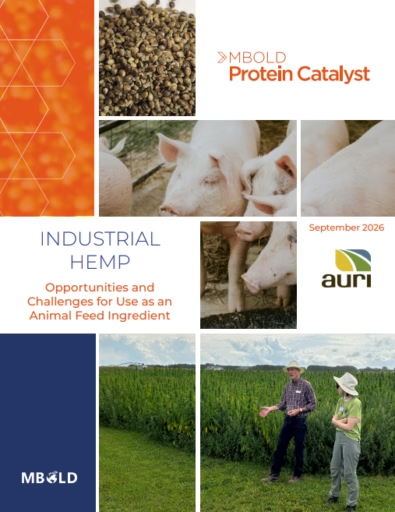
MBOLD, an initiative of the GREATER MSP Partnership, recently released two reports as part of its Protein Catalyst initiative: one on canola and the other on winter camelina. These reports are the latest in a series of publications aimed at identifying emerging and alternative crops that can be scaled for use in animal feed and sustainably meet future protein demand. A report on industrial hemp meal was also recently released and will be highlighted in a future Ag Innovation News.
By 2050, the demand for protein is projected to increase by 50%. Thanks to MBOLD and many collaborating organizations, Minnesota is well-positioned to capitalize on the expected growth.
“The MBOLD coalition brings together well-known and successful food and agriculture companies we have here in Minnesota and leverages that expertise and market know-how to start addressing the challenges facing food and agriculture globally,” says B.J. Haun, MBOLD’s director of agricultural resiliency.
Canola is an established crop that provides a constructive framework for emerging oilseed crops to scale acreage and market acceptance. Winter camelina, a new oilseed that has similarities to canola, has attracted strong interest from value chain partners seeking to expand production and
market opportunities.
The crops highlighted in these reports provide growers with greater diversity not only in terms of planting options but also in the products they can sell. When oilseeds like canola and winter camelina undergo the crushing process, both oil and protein meal are produced.
“The animal feed market is a great outlet for the protein meal because it yields a high value return for that product,” explains Alexandra Ostlund, business development director of novel supply chains at the Agricultural Utilization Research Institute (AURI).
AURI is a member of the MBOLD coalition and plays a leading role in conducting and managing research on new animal feed ingredients of interest to the coalition.
In effect, the latest Protein Catalyst publications complement each other. The canola case study illustrates a recent success story, while the winter camelina report explores the potential and challenges that lie ahead to scale a new feed ingredient.
The Roadmap: Canola
During the second half of the 20th century, a group of Canadian researchers was determined to develop a rapeseed cultivar for producing edible oil and meal for animal feed. Back then, rapeseed oil was primarily used as an industrial lubricant; its high erucic acid content made it unsafe for human consumption, and its glucosinolate levels made the meal problematic for livestock consumption.
Over decades, scientists labored to develop new varieties with lower levels of both. Eventually, they succeeded. The Rapeseed Association of Canada registered the canola trademark in 1978, distinguishing these new varieties and removing the two major roadblocks in its path to greater marketability.
Market acceptance, however, was farther down the road. To get there, the Rapeseed Association of Canada created a multidisciplinary research committee focused on gaining market access, funded through a voluntary levy paid by rapeseed crushers and exporters, supplemented by federal government support. Additionally, the industry banded together to form the Canola Council of Canada, an association that included members from across the supply chain who provided additional funding. This coalition aligned stakeholder interests and research priorities to ensure that the latter remained focused on market development.
Moreover, the effort included engagement with animal nutritionists at universities to conduct feeding trials, publish peer-reviewed studies, participate in symposia, and undertake extension activities to provide the feed industry with trusted information on the benefits of canola meal.
Through these combined efforts, a product that was once of limited commercial interest is now second only to soybean meal as the world’s most widely consumed oilseed meal in animal feed.
The Journey Begins: Winter Camelina
Winter camelina caught the interest of the Protein Catalyst initiative for several reasons. First, the winter camelina plant is hardy enough to withstand the harsh conditions of Minnesota’s winter season. Second, because it is planted in the off-season, it provides the benefits of a cover crop, such as maintaining soil nutrients and preventing soil erosion and nitrate leaching. And thirdly, it offers farmers the opportunity to harvest an additional
cash crop.
“Efforts are focused on illustrating how winter camelina can be a complement versus a competitor to the traditional
corn-soy rotation common in the Midwest,” says Ostlund.
University of Minnesota research has shown that a dual-cropping system, such as double- or relay-cropping winter camelina with soybeans, can increase oil output per acre by 50% compared to standard single-crop systems. Exploring winter camelina through this systems approach illustrates both its cumulative environmental value as a cover crop and the increased economic outputs from additional oil and meal.
On the other hand, as an emerging crop, winter camelina meal research is still needed to improve its value against the industry standard of soybean meal in the feed market. Winter camelina meal contains antinutritional factors, such as glucosinolates, and has a less complete amino acid profile compared to soybean meal. As a feed ingredient, winter camelina’s nutritional profile is most similar to canola.
Additionally, Ostlund notes, “It will be necessary to address supply chain gaps and bottlenecks to increase the inclusion rate in livestock feeds and expand the types of livestock that it can be fed to.”
Presently, the Association of American Feed Control Officials’ (AAFCO) camelina meal definition is for no more than 10% inclusion in the diet and limits its use to broiler chickens, feedlot cattle, and
laying hens.
The MBOLD camelina report concludes with a set of recommendations, including calls for additional feeding and safety trials, further pricing analysis, more research into minimizing or eliminating antinutritional factors, and a deeper examination of how other market opportunities, such as biofuel demand, could boost the availability of winter camelina meal for use in
animal diets.
Destination: A Million Acres
It is estimated that Minnesota farmers seeded about 5,000 acres to winter camelina last year. MBOLD, along with its partners, aims to expand the planted area to a million acres.
“We want to double the acreage every year if we can,” says Haun.
At that rate, winter camelina would hit the million-acre milestone in a decade.
“These reports are not merely white papers,” emphasizes Haun. “They tell us what needs to be done, and how we are going to go do it. We are all going to have to roll up our sleeves and tackle some of these challenges. Whether it is MBOLD or industry members or university researchers, everyone has their lane to make this happen.”
For Ostlund, that call for a coordinated, all-hands-on-deck push is the biggest lesson to be drawn from the canola case study.
“What made canola successful,” she sums up, “was the coalition building — the collaborative spirit that rallied public, private, and academic institutions around a common mission and zeroed in on what needed to be done.”