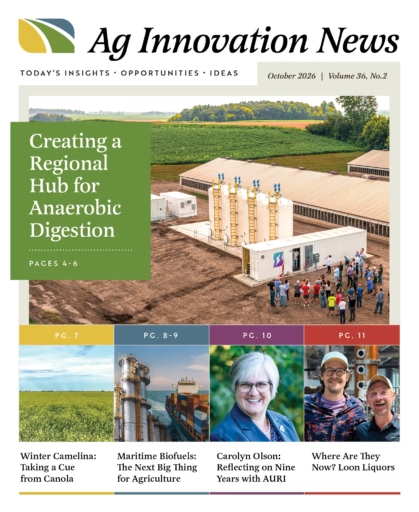
Minnesota has the agricultural resources, energy demand, and technical expertise to become a national leader in anaerobic digestion. The Agricultural Utilization Research Institute (AURI) is helping build the connections and capabilities needed to turn that potential into a growing industry.
The United States is making significant progress in capturing biogas from agricultural operations, but much of the opportunity remains untapped.
According to the American Biogas Council’s 2026 annual report, U.S. agricultural operations are producing 166 percent more biogas than they were five years ago. Yet the organization estimates that the country has the potential to support more than 11,200 on-farm biogas facilities, including as many as 1,405 in Minnesota alone. This estimate does not include possibilities for agriculture-adjacent biogas plants at food, biofuel, wastewater treatment, and other facilities that handle or produce organic waste.
Today, Minnesota has 49 facilities that produce and capture biogas, including 26 water resource recovery facilities, 4 landfills, 17 on-farm facilities, and 2 food waste systems.
For AURI, that gap represents both an opportunity and a challenge: How can Minnesota translate its abundant biomass feedstocks into renewable energy and recover the plant nutrients locked in the waste, while creating economic value for farmers, businesses, and communities?
For the last five years, AURI has worked to help answer that question through applied research, business development, technical advising, partnerships, and knowledge sharing. In 2026, that work expanded through new industry partnerships, investments in research capabilities, and links with biogas leaders both nationally and internationally.
Together, those efforts are helping establish what AURI Business Development Director of Biomass Feedstock Brad Matuska describes as a potential regional hub for anaerobic digestion in the
Upper Midwest.
From swine manure to renewable natural gas
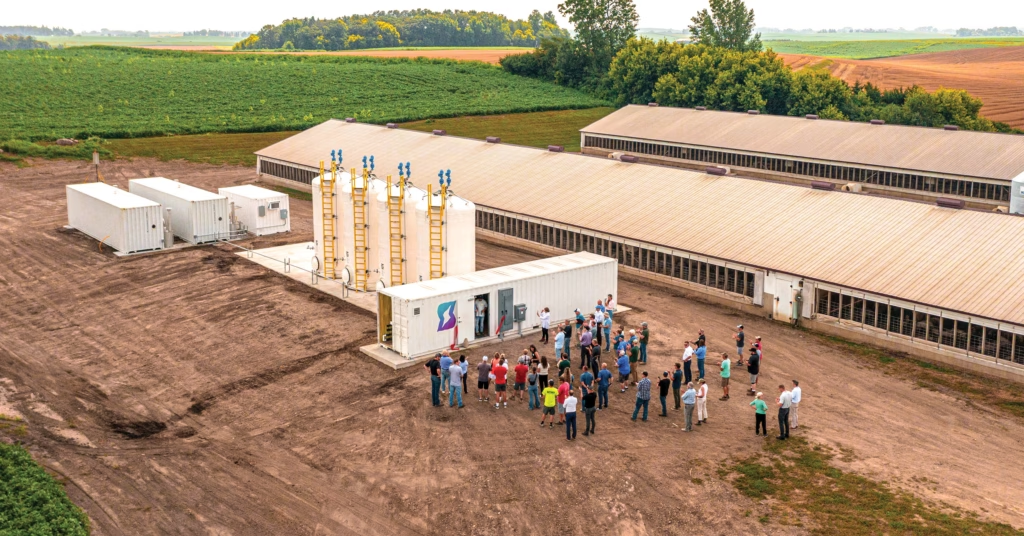
One of the clearest examples of this work is AURI’s partnership with Swinergy, a Minneapolis-based clean technology startup founded in 2022. The company converts swine manure into renewable natural gas (RNG) and sustainable fertilizer.
In August 2026, Swinergy hosted a ribbon-cutting event for its first project at a farm near Ellendale, Minnesota. The project represents the first commercial application in the Upper Midwest of the company’s patented technology to produce RNG from manure collected from a swine pit-barn operation. Swinergy already has more than a dozen farms interested in deploying the technology. That technology not only facilitates biogas production but also impacts how manure is managed, resulting in a more sustainable operation.
“On many larger swine farms, manure is stored in deep pits beneath the barns and may only be removed once or twice a year,” Matuska explains. “As the manure sits, biological decomposition occurs, and methane is released before it can be captured and used. Swinergy developed a system that allows producers to remove manure more frequently, recover more of that methane through anaerobic digestion, and then store the resulting digestate until it is land-applied as fertilizer. It requires a change in how manure is handled on swine farms. But now that the model is being demonstrated, learnings can be adapted to different farm configurations and regions across the state.”
Swinergy’s first commercial project is the result of years of technical development, which included collaboration with AURI. As a young company with only a handful of employees, Swinergy initially lacked access to the sophisticated laboratory equipment needed to determine feedstock properties and validate its applications.
That is where AURI became an important partner.
“We needed someone we could send feedstock samples to characterize for us and help develop the process,” said Swinergy founder and CEO Eugene Alvey. “That is where AURI stepped in. We could use that output to validate how we performed. It was an invaluable resource to know that lab results from AURI for this specific need to advance this foundational aspect of the business were available without having to build out our capabilities at a cost of tens of thousands of dollars.”
The relationship illustrates one way AURI can help emerging technologies move from the laboratory to commercial use: by providing access to technical resources that might otherwise be out of reach for an early-stage company.
Swinergy’s technology also demonstrates that anaerobic digestion can process more than one type of feedstock. Although its first commercial use focuses on swine manure, the process can also be adapted for other organic materials, including food and industrial waste.
Alvey points to ethanol production as one potential application. Ethanol plants could use the same method to convert low-value side streams of the corn-ethanol process into biogas. The biogas could be used to meet the ethanol plant’s energy demand, lowering the ethanol’s carbon intensity. In turn, ethanol could become more valuable in critical emerging markets such as sustainable aviation fuel (SAF) and marine transportation.
Building connections across the agricultural economy
AURI’s role with Swinergy has extended beyond technical assistance.
As the relationship developed, AURI’s network and reputation as a trusted resource helped the company establish ties with agricultural organizations, potential customers, and other partners. In 2025, AURI also featured Swinergy at its booth at Farmfest, giving the startup an opportunity to reach an audience it would have been difficult to reach on its own.
“We were there for two days, and in that time, we had the Governor of Minnesota, both U.S. Senators, and two U.S. Congressmen stop by and see our model to learn more about us,” Alvey notes.
For a small company working to commercialize new technology, those interactions and access to market resources are as important as technical resources.
“Now, as we are looking into new models, there is so much overlap with AURI,” Alvey says. “AURI can play a very effective matchmaking role and bring someone’s problem together with someone’s solution. As a small, Minnesota-based startup working to increase the utilization of ag products to further develop renewable energy from biogas, we really hit the trifecta.”
Matuska sees the Swinergy project as an example of what can happen when technical innovation is paired with business development and industry support.
“This is an amazing success story,” Matuska reflects, noting that the project required solutions to significant financial, logistical, and technical challenges. “The success of this project will serve as an example to farmers and entrepreneurs of what is possible to achieve through anaerobic digestion. The project also demonstrates the financial and community benefits to these partnerships.”
Learning from a global biogas leader
While Minnesota is developing its own biogas industry, AURI is also looking beyond the state—and beyond the United States—for lessons that could help accelerate that growth.
In March 2026, Jimmy Gosse, AURI’s senior scientist of biobased & renewable energy, participated in a “Biogas Fact-Finding Trip to Denmark” sponsored by Denmark’s Ministry of Foreign Affairs.
The North American delegation toured biogas facilities, exchanged technical knowledge, and met with scientists and industry peers. The trip provided an opportunity to examine how Denmark has integrated agriculture, business, government, climate policy, energy, utilities, and research into a coordinated biogas ecosystem.
The Danish Energy Agency reported that in 2023, the share of RNG in Denmark’s gas system reached nearly 40%. Denmark is expected to be at 100% renewable electricity by 2030 and 100% renewable energy by 2050, providing a useful example for countries and regions looking to expand renewable gas production.
Gosse said Denmark has developed an ecosystem that rewards innovation while aligning stakeholders around shared goals. The experience will help strengthen collaboration between entities in the United States and Denmark working in the biogas sector.
The trip was led by Jeppe Juul Petersen, special attaché, food & ag, at the Consulate General of Denmark, and Thomas Sand Nielsen, associate commercial advisor, at the Consulate General of Denmark. Nielsen attended AURI’s Minnesota Renewable Energy Roundtable in 2025 and left the event excited about developments in Minnesota. He has continued his relationship with AURI following the event.
“Our two hosts were exceptional,” Gosse underscores. “Their attention to detail and ability to move us through complex tours and points of interest with a packed schedule was amazing.”
A highlight was a tour of the Måbjerg Biogas facility in West Jutland, one of the world’s largest large-scale biogas and bioenergy plants. The delegation learned about the facility’s history, evolution, and expansion plans, as well as how the surrounding community approaches climate and energy issues.
The connections made through the trip have already generated opportunities for collaboration. The lessons from the fact-finding mission, which was attended, among others, by representatives of Iowa Soy and the Pennsylvania State University (Penn State), led to AURI’s participation in an Iowa Agriculture Water Alliance meeting and to an invitation to present the findings of AURI’s publication, The Biogas Opportunity for Minnesota Farmers: A Business Guide for On-farm Anaerobic Digestion, at a national conference at Penn State. The relationships illustrate the value of bringing together people and organizations working on similar challenges across different regions.
Investing in better science and better decisions
AURI is also expanding the scientific infrastructure needed to support the industry.
In May 2026, AURI and the Swedish company BPC Instruments announced a strategic partnership to improve the quality, comparability, and decision relevance of anaerobic digestion experimentation in the United States.
BPC Instruments is a global provider of analytical instruments used in biogas, biodegradability, animal nutrition, and wastewater studies. BPC and AURI will collaborate on applied research and professional services, education and workforce capacity building, and training on BPC instruments.
The work will take place at AURI’s Bioindustrial Innovation Center in Waseca, Minnesota, with an emphasis on rigorous anaerobic digestion testing methodologies and sound interpretation of results.
That capability is increasingly important as developers, farmers, and investors consider new feedstocks and new business models. Reliable data can help determine whether a potential project is technically feasible, how a feedstock performs under different conditions, and where a project’s economic opportunities and limitations may lie.
AURI also expanded its anaerobic digestion capabilities at its Waseca facility in 2026. The organization operates an anaerobic digester that clients can use to evaluate different feedstocks, and recent upgrades will enable more sophisticated testing, including custom tests using new approaches and strategies.
Most agricultural biogas production today occurs on dairy farms. The expanded capabilities at AURI’s Waseca facility create additional opportunities to better evaluate swine and poultry manure, as well as food waste and other feedstocks like crop residuals and others.
That diversity matters if Minnesota is going to move from a relatively small number of biogas facilities toward the much larger potential identified by the American Biogas Council. Exploring co-digestion of a mix of feedstocks could be the unlock for more farmers to participate in this value-
added area.
Creating an ecosystem for growth
The opportunity for anaerobic digestion in Minnesota is ultimately about more than individual digesters or technologies.
It involves farmers with feedstocks and waste streams, technology developers, researchers, utilities, energy markets, policymakers, investors, and communities. It also requires reliable scientific data, sound business models, and mechanisms to connect people with problems to those with solutions.
Minnesota has many of the pieces already in place.
“We are right in the middle of a perfect convergence,” Matuska explains. “We have the feedstock here, and we have the market created by the demand for biogas in RNG and electricity. We could see a significant number of new facilities come online in the near future. Our role at AURI to continue this expansion is critical,” Matuska says.
AURI will provide technical expertise, data, and economic and business analysis while leveraging its network to bridge stakeholders across the agricultural and energy sectors.
The challenge is to link all the pieces in a way that allows the industry to grow responsibly.