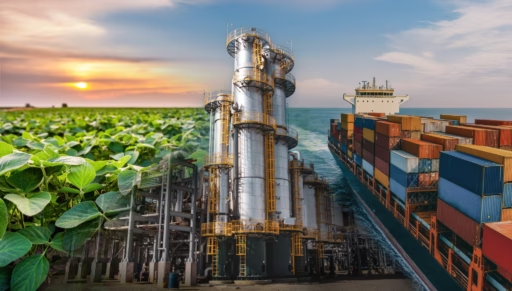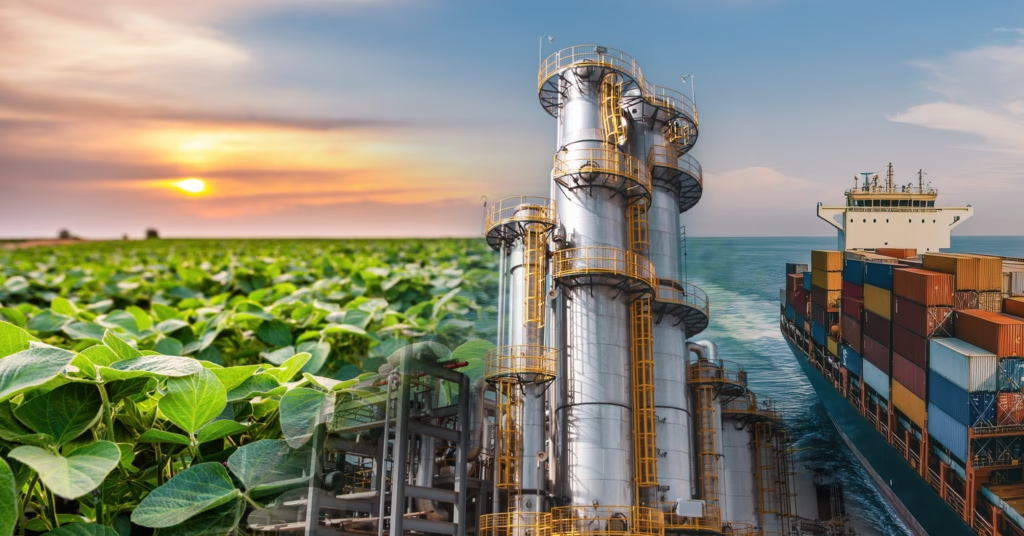
The emerging maritime biofuel market is the “biggest, ready-now” opportunity for U.S. farmers, according to Sanchit Mulmuley, Head of Renewable Natural Gas (RNG) for Roeslein Renewables.
The maritime sector could become the first global transportation industry to be subject to a regulatory framework that combines mandatory limits on greenhouse gas (GHG) intensity with sector-wide emissions pricing. MARPOL, the International Convention for the Prevention of Pollution from Ships, focuses on air pollution and GHG emissions from ships. Specifically, Annex VI of MARPOL addresses air pollution from ocean-going ships. In December 2026, pending confirmation, parties to MARPOL Annex VI are expected to reconsider adoption of the International Maritime Organization (IMO) Net-Zero Framework. The framework would progressively tighten the allowable lifecycle GHG intensity for marine fuels and require ships that exceed those limits to acquire compliance units, including through payments into an IMO Net-Zero Fund.
The Agricultural Utilization Research Institute (AURI) hosted a webinar last June, moderated by Brad Matuska, AURI’s business development director of biomass feedstocks, that examined the promise of this emerging opportunity.
“To put things in perspective,” Matuska remarked, “maritime shipping uses an estimated 87 billion gallons of fuel per year.” This total is similar to the global aviation industry volume.
Driving Agriculture’s Future
The webinar (now posted on AURI’s YouTube channel and titled “Why Minnesota’s Agricultural Industry Has a Stake in Maritime Decarbonization Through Renewable Fuels”) addressed why the state’s agriculture sector should care about maritime shipping and why it is uniquely positioned to lead as a
biofuels supplier.
Matuska explained that not only is the maritime shipping sector already using some Minnesota-produced biofuels, but it also moves those grains and other agricultural goods around the world via the Great Lakes and the Mississippi River.
“With its strong biofuel production capacity, feedstock capability, abundant biomass resources, existing infrastructure, and direct access to major waterways, Minnesota can link inland fuel production to export demand from international buyers. For this reason, Minnesota is uniquely positioned to lead,” he said.
The webinar focused on three different types of biofuels: ethanol, biodiesel, and biogas.
Brian Werner, executive director of the Minnesota Bio-Fuels Association, kicked off the panel discussion by highlighting the potential benefits of maritime decarbonization for ethanol producers. In the U.S., ethanol production has been trending upward due to depressed corn prices and higher fuel costs. The challenge, he said, is finding a market for the increased volume. In this respect, the maritime biofuel market represents the biggest opportunity. The shipping industry is starting to adopt ethanol, and demand for the biofuel is expected to reach 6.4 billion gallons by 2030.
“In 2025, the U.S. produced about 16.5 billion gallons of ethanol. If we capture even 5% of the 87-billion-gallon global maritime market, ethanol demand would increase by 4.3 billion gallons, representing about a quarter of total U.S. ethanol production. That would equate to 1.5 billion bushels of corn,” Werner observed.
An S&P Global report warns that, as yields continue to improve, corn production is currently outpacing demand. Left unaddressed, this imbalance could result in a significant reduction in cultivated land and/or continued declines in crop prices, exposing both producers and consumers to market volatility and reduced margins. Increased biofuel demand, the report concludes, could serve as a catalyst for transforming U.S. agriculture, reviving rural economies, and providing global food and energy security.
In closing, Werner added that increased ethanol production would not only help meet biofuel demand but also increase the volume of coproducts that result from the ethanol production process. Coproducts such as protein, fiber, and corn oil could be reintegrated into the food and feed systems.
Mulmuley of Roeslein Renewables next explained how increased foreign competition at competitive prices has cost the U.S. a significant share of the global commodities trade, making it vital for U.S. agriculture to find new markets.
Considering that maritime biofuel demand could account for 30% of all global liquid renewables demand in the next 5-7 years, “this could be a $10-15 billion market for U.S. agriculture,” Mulmuley said. While multiple fuel pathways are being explored, recent studies indicate that bio-liquefied natural gas (bio-LNG) made from biogas may offer one of the most practical near-term solutions for maritime decarbonization. Global biomethane production could potentially meet a substantial portion of the shipping sector’s initial demand for low-emissions fuels, creating a significant new market opportunity for agricultural residues, manure-based biogas, and other feedstocks.
Matt Herman, chief officer, demand and advocacy for the Iowa Soybean Association, rounded out the panel. Speaking specifically about biodiesel, he noted that because these fuels can be blended with traditional fuels, the need for supply chain investment is relatively small. Regarding feedstock, he explained that the maritime sector could use certain energy-dense oilseeds that may be problematic for the transportation supply chain, thereby diversifying the crop options available to farmers.
On policy, he emphasized two priorities: the importance of obtaining Renewable Identification Numbers (RINs) for biofuels to make them eligible to participate in this market, and the need to closely monitor how carbon intensity scores will be determined.
“There are going to be growing pains,” he acknowledged. “We are going to have to work through them in a coordinated fashion.”
Moving Forward
To Herman’s final point, AURI is dedicating its next Minnesota Renewable Energy Roundtable to further exploring the opportunity represented by the decarbonization of the maritime shipping sector. This annual event brings together more than 200 researchers and educators, business and industry leaders, and government and NGO representatives.
The 2026 Roundtable, to be held this December 16 in Minneapolis, will move beyond raising awareness to identifying practical, infrastructure-grounded avenues to participation in the emerging maritime biofuel markets. The featured panel discussions will examine how different biofuels, including ethanol, biodiesel, and bio-LNG, can be used and transported, and identify the challenges to advance this market opportunity, including logistical chokepoints and bottlenecks that require attention.
“We have to start talking about specific pathways of how biofuels produced by Minnesota farmers can be utilized,” notes Matuska. “The use of biofuels in the international maritime space is a significant market opportunity. If properly developed, it could be a benefit to agricultural producers across Minnesota, the Upper Midwest, and
the country.”
Stay tuned for the details of the 2026 Roundtable on AURI’s “Events” website page.